RARE BOOK GUIDE - THE RUNNERS, THE RIDERS & THE ODDS

01 July 2008

Red Roses from Texas, 1964.


"Three times that day in Texas we were greeted with bouquets of the yellow roses of Texas. Only in Dallas they gave me red roses. I remember thinking: How funny - red roses for me." Jacqueline Kennedy.


Nerin Gun ( with Thomas Buchanan.) RED ROSES FROM TEXAS. Frederick Muller, London, 1964.

Current Selling Prices
$400-$600 /£200-£300


KENNEDY ASSASSINATION / CONSPIRACY THEORY
Kennedy assassination conspiracy theory book --looks like a novel but is non-fiction. The 1964 British Muller edition is the only edition of this book and I don't think there is even a second edition. Something of a sleeper which I am slightly reluctant to awaken but as I am now in my anecdotage I am less guarded about these things. This is a book that looks like nothing, one of the first conspiracy theory books to appear after the Kennedy assassination and, so far, always exchangeable for a £100 note minimum.

The book has been surpassed by many later works and is generally discounted as poorish stuff by Kennedy assassination conspiracy theorists. The findings of Nerin E. Gun (with Thomas Buchanan, who wrote Who Killed Kennedy?) were ridiculed as Communist garbage by the psycho FBI Director J. Edgar Hoover when he testified before the Warren Commission on May 14, 1964. A later review by Walt Brown cites various inaccuracies:-
Gun was there, in Texas, and Mexico, for much of the time between the assassination and his subsequent publication. His asides, commentaries on Texas, political assassinations in general, the life and times of JFK, and the events that made November 22 unique, are well taken, but they turn a narrative into what seems like a series of essays or thought pieces. And, again, much is wrong. It wasn't 85 degrees in the shade that day, the SS were not all carrying submachine guns on the running boards, and half of the SS agents did not stay in Dealey Plaza. Nor were witnesses Harold Norman, Jr. Jarman, nor Bonnie Ray Williams cited. Instead we learn of "Negroes" under the sniper's window named Ralph Erwing and Washington Harris. Is it real or is it Memorex??????
VALUE? There are several copies on the web at between $500 and $800, with some guy on Amazon (often the source for the cheapest and also the most grossly overpriced copies of books) wanting $500 for a non-jacketed ex-library cop and a fine in fine example being available at $600 elsewhere. We have sold two very nice jacketed copies this century both at £220 each. The book is not especially scarce and can be found overlooked in a charity shop if you are lucky - and they are not plugged into the mainframe.

Outlook? Eventually it will be reprinted or POD'd so not a book to hold. It has been about the same price for 5 years, so if you find a copy, sell it. We put a fine one on Ebay where it failed to make our modest reserve - confirming my feeling that, unless you have something very trendy or very rare Ebay's customers tend to be bargain hunters, cheapskates and bottom feeders. At least that's why I go there!

30 June 2008

Arson 1942 / Toni del Renzio


Toni del Renzio. ARSON. AN ARDENT REVIEW. Part One of a Surrealist Manifestation. London, 1942.

Current Selling Prices
$250-$600 /£120-£300


SURREALISM / MAGAZINE
Although billed as 'Part One' this was the only issue of this surrealist magazine of 'incendiary innocence' ever to appear. Several other magazines, mostly smaller in format and associated with E.L.T. Mesens appeared and all have become quite hard to find and consequently expensive. Del Renzio was a key figure in British Surrealism, never a burgeoning movement but oddly attractive and now quite collectable. Under the headline 'SUPERDAD' the art journal 'Studio' published this obituary for him in Febuary 2007:-
Toni del Renzio has died aged 91. Truer than life always, he was born to a landed Italian family outside St Petersburg, where his father was a diplomat to the Tsarist court. He had a legendary and varied life, not least in contributing to Studio International, with whose editor, Peter Townsend, he established a natural rapport. Fluent in several languages, he had fought in the Spanish Civil War but ended up in the lap of the Surrealist movement in Paris. On eventual arrival in London, he founded the Surrealist magazine Arson. In 1951 he joined the Institute of Contemporary Arts and was involved on exhibition panels and juries. For a time back in Italy, he became the Fashion Editor for Harpers Bazaar, and then reorganised the Milanese magazine Novita as Vogue Italia. He staggered his friends and acquaintances much later on by becoming, at the age of 70, the father of quadruplets, two sons and two daughters: and then wrote about it as if it was the most natural thing in the world, which for del Renzio, it was. His métier was the surrealist collage. He became distinguished as a teacher, both at Bath and subsequently at Canterbury, where he was Head of Art and Design History. Vale, ti saluto, Toni del Renzio, maestro.
Antonio Romanov del Renzio dei Rossi di Castelleone e Venosa (to give him his full name) was a mercurial character and as a surrealist spent a lot of time engaged in aesthetic and political arguments, being at one time being considered a monster by the Mesens crowd. His key work 'Arson' was partially financed by Ithell Colquhoun whom he married in 1943 and divorced in 1948. He was also, briefly, the lover of the surrealist painter Emmy Bridgwater. In 1942 he also mounted a London exhibition entitled Surrealism resulting in more general recognition for the movement. 'Arson' was printed on turquoise stock and decorated on the front cover with surrealistic appropriations of steel engravings, printed in purple. Collage was a favourite medium for del Renzio. Contributors included Robert Melville, Giorgio de Chirico, Conroy Maddox, Nicolas Calas, Pierre Mabille + an interview with André Breton. Books by TDR are quite collectable--his 1968/ 1969 paperback on hippies 'The Flower Children' (no copies anywhere) must be worth £30 by now and his 1971 book 'After a Fashion' is highly elusive.

VALUE? A copy of Arson, not nice but complete, went through Ebay earlier this year at $199. There are 2 copies at ABE as we speak at £300 (call it $600) neither fine and one with chips at the edges. It probably sells easily at $300. £300 may be achievable as you have to have it if you collect British surrealism. The entire printed output of the British cadre of the movement would probably fit in one regular book box. I guess the top book would be Nancy Cunard's 'Salvo for Russia' also London, 1942. It was co-edited by the artist John Banting. 100 copies printed, last auction record £130 in 1976. I want it.

Outlook? Unknowable, search me guv etc., Pressed for an opinion I would say healthy - because it's quirky, visual and ephemeral. Below is a pic (mixed media and watercolour on paper) by the equally longlived (Birmingham) surrealist Conroy Maddox from 1940, that gives a flavour of the movement.

29 June 2008

Tall Tales from the Trade 2


It's 1977, in the year of the Jubilee, punk rock is in the air, Big Jim Callaghan is in Downing Street and a bookseller in King's Cross London is involved in a long - running dispute over rent with a corrupt and greedy landlord. The landlord, call him Rachman, wants him out so that he can develop the building into flats and keeps raising the rent and hassling the young bookseller at every opportunity.

The guy supposedly owes £5000 in back rent and 'reparations' and on a Thursday evening a bailiff in a bowler hat arrives with a couple of thuggish sidekicks to seize the guy's entire stock in lieu of this amount. It is a very smart and well chosen stock worth £50K minimum but if seized it will be sold at Pecksniffs - a seedy auction house specialising in bankrupt stock. It will probably make a tenth of its true value and our bookseller will be destitute -sans money and sans books. He manages to persuade the bowler hatted one to accept £100 and says that he will have the rest on Monday after he has been down to the country to borrow the money from his father. This is quite plausible because the guy, like a lot of booksellers of the time, appears to be a public school type with a vague air of privilege, albeit slightly shabby, and likely to have moneyed parents. In fact his dad was a teacher with nothing more than a flat in Roehampton and a bicycle.

The bailiff disappears into the gathering gloom and the dealer immediately gets on the blower to his network of dealer friends. The call goes out to the London trade that he will buy any book for 5 pence (10 cents.) Battered Volvos, trucks, vans arrive laden with London's lousiest, most unsaleable books. I recall we sent 500 crap books along (quite handsome tomes but mostly in Finnish) and got £25--in 1977 you could have quite a jolly weekend with sums like this.

By Monday morning the stock has had a blood transfusion and our man has spent £500 and taken all his good books home. The bailiffs duly appear, he gives them his hard luck story and they heartlessly seize all the books in the shop, load them into a Luton, call him a loser and take their booty forthwith to Pecksniffs- where a month later they are sold for a sum in the very low hundreds. By which time our man has decamped, returning after a longish spell in Ibiza to do book fairs and sell by catalogue. The enraged landlord gets a cheque from Pecksniff's --a paltry sum less 25% and later has to foot a £500 bill from the thuggish bailiff. A few years later he is jailed for threatening tenants.

30 years later, no names, no packdrill, our dealer has 60,000 books on the web and most weeks grosses £5000. He has bought his old dad a Mondeo to take him to the bowls club in Roehampton. Never mind the bollocks...

27 June 2008

Tall Tales from the Trade

A bookseller specialist buys a large academic collection from an old professor--mostly sexology, sexual politics, censorship and moral studies. He gets them for a reasonable sum, but part of the deal is that he takes 10,000 porno paperbacks stored in the outhouse. Reluctantly he hauls them all out and takes the paperbacks to the recycling where they are pulped. Pulp to pulp.

Painstakingly he lists the scholarly works and offers them to a University library that he has ties with. They reply that, sadly, they have most of these books and what they really need is actual porn paperback fiction, 'we have all the books on censorship' the librarian says 'what we need is the material that was being censored - we need thousands of them, but I'm afraid we can only pay $20 each.'


I was reminded of this one when reading about David Hockney and his choice of book on Desert Island Discs. It was a gay pulp porno paperback 'Route 69' by Floyd Carter which he was allowed to take to his island along with the Bible and complete works of Shakespeare. There are no copies of Floyd's masterpiece on any web mall and the only works showing by him are Battle of the Bulges , Big Joe, Camp Butch and Forbidden Fruit --mostly on Amazon where they report no copies. These books tend to be rare.

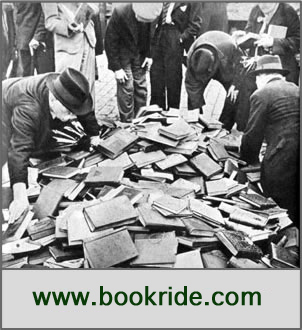
A similar tale is set in 1965 in a provincial bookshop where trade is slow. The dealer has a sale of the books upstairs, lesser books but useful stock--even after severe reductions there are 10,000 books left. Rather than haul them down to the dump he decides to give the whole lot to the young girl who comes in on afternoons when he is out doing house calls, fishing, watching cricket etc., She graciously accepts them and says she will arrange to have them out as soon as possible. He sets off to a local auction and on his return is greatly surprised to find all the books have gone. The girl explains that a guy came in from a movie company needing 10000 books - for the book burning scenes in Fahrenheit 451 that they were filming nearby. She only charged £1 per book.

25 June 2008

An American Prayer. Jim Morrison, 1970


Jim Morrison. AN AMERICAN PRAYER. Privately Printed ( by Western Lithographers in Los Angeles but not stated.) 1970.

Current Selling Prices
$2500-$4000 /£1200-£2000


POETRY / ROCK
12mo. 5 inches tall and 4 inches wide in slightly grained burgundy red boards gilt lettered on the cover. Has the appearance of a prayer book. Sometimes described as being bound in leather but believe me, it's faux. The only information printed inside is '© James Douglas Morrison 1970 All Rights Reserved' printed at the bottom of the verso of the blank front endpaper. It has 40 unpaginated pages, 37 printed. This is the first edition that Morrison had printed in 100 copies (?) as described at OCLC / World Cat and conforms with the copy sold at Pacific Book Auctions in 1993 (for $500.) A single visionary poem in Morrison's peak Dionysian style full of incantation-- 'Give us a creed/ To believe/ A night of Lust/ Give us trust in /The Night...'

Sometimes thought to be 500 copies, but it's pretty scarce and OCLC shows only two holdings - at La Jolla (San Diego University) and Berserkly. I incline towards the 100 copies school. We bought a copy from the estate of contemporary American composer Lou Harrison in Aptos, California and it was the only nod towards Rock in the entire collection of books and records. I was told by his acolytes that Lou had considered 'Light my Fire' an inspired work.


VALUE? Our copy was described thus: 'Attractive bright condition with very slight handling wear i.e. very slight marks and a discernible hairline crack at upper spine hinge - overall VG or better. Issued without d/w.' It is a vulnerable little book. We got $2200 for it in 2003 after a month or two on the net and sold it to a high end dealer who attempted to double up. He may have achieved this; Jim Morrison is, was, and always will be, hotter than a 2 dollar pistol.

A reprint was published in Louisiana in 1983/84 that some people want $300 for but is apparently sanitised. The LP and CD have 90% of the uncensored lyrics in a booklet and don't cost much. At a Rock memorabilia sale in London 2005 someone paid £1080 against an estimate of £1000/ £1500, no condition noted. A fabulous signed copy has sat on ABE at $15000 since Blair was our leader (and has now been joined by another.) The earlier seller notes: 'The majority of copies, which were subscribed to, were sent out in mailers bearing the address of the Doors Fan Club, Santa Monica.' This argues quite forcibly against the 100 copies theory because the boys had more than a 100 fans. However the book seldom shows up at all. An enigma. It has been known to show up in Bible stores as it has the deliberate appearance of a little prayer book. Jim was buried in July 1971 at Pere Lachaise cemetery in Paris not far from Oscar Wilde, Molière, Chopin, Edith Piaf, Sarah Bernhardt, Marcel Proust and, best of all, the assassinated Black Prince who lies serenely on top of his grave. Due to the constant traffic of his fans Jim's grave is a bloody disgrace -as befits a wild rock star.

Outlook? It is likely that history will see Jim as the Baudelaire of rock and he is unlikely to fade away. Danny Sugarman, a sort of Max Brod to Jim's Kafka, says that '...Jim Morrison didn't want to be a god. Jim Morrison wanted to be a poet. Surely, no modern poet has written better of the alienation and feelings of isolation, dread, and disconnectedness ... Jim's dying wish was to be taken seriously as a poet. While he was alive, his behavior blinded many of us to his words. Today his life still fascinates and amazes us, and his work as a poet is finally gaining the recognition it deserves...' This is born out by the 2006 $50000 auction record (the last significant record for Jim material) for a 12 line poem in his hand "...in black ballpoint pen on a sheet of lined paper , circa 1970, the 12 lines on one sheet of lined paper titled 'The American Night' beginning with the first verse 'When radio dark night existed + assumed control + we rocked in it's web consumed by static stroked w fear' and the second verse reading 'we were drawn down / The distance of long cities riding home thru the open night alone launching fever + strange carnage from the back seat.'" These verses are a version of a poem in this little book that I devoutly hope to find again.

21 June 2008

The Grapes of Wrath


John Steinbeck. THE GRAPES OF WRATH. Viking Press, New York (1939)

Current Selling Prices
$4000-$10000 /£2000-£5000


MODERN FIRST EDITION.
Tolstoyan novel with important social content. The book that won Steinbeck the Nobel prize. Basic plot is this - forced from their home in the south by the dust storms (Dust Bowl), the Joads, a family of 'Okies' are lured to California to find work; instead they find disillusionment, exploitation, and hunger. The Oxford Companion to Literature says that '...it articulates a life-affirming 'mystical socialism' and speaks eloquently for the concerns of the deprived and the dispossessed.' It sold nearly half a million copies in its first year of publication, although it had its detractors - Steinbeck was accused of everything from harboring communist sympathies to exaggeration of the conditions in migrant camps. The uproar drew the attention of Eleanor Roosevelt, who came to Steinbeck's defense, and eventually led to congressional hearings on migrant camp conditions and changes in labour laws.

His wife came up with the title -- from the lyrics of "The Battle Hymn of the Republic" ("Mine eyes have seen the glory of the coming of the Lord; He is trampling out the vintage where the grapes of wrath are stored... ") -- and typed up the manuscript as he wrote in Los Gatos. Los Gatos is now a chic town on the edge of Silicon valley, with about one restaurant for every 100 people and a shopaholics paradise, then it was a merely agricultural town. Both its bookshops are now closed. The one on the top corner of the main drag which was run as late as the 1990s by an old cove with a Jaguar is remembered fondly. Over the hill in populous Salinas (his birthplace) the John Steinbeck Public Libray was faced with extinction in 2005 (no money) but at the last moment the citizens of Salinas voted themselves a sales tax to keep the library and other city services funded for the next ten years. In Monterey , Steinbeck mementoes are everywhere and some of the canneries near the front have become antique markets - with the occasional bookdealer, always with shelves of Steinbeck. He is the California writer, the Beach Boys sang about him... (pace Jack London.)


VALUE? For serious money you need the original color pictorial dust jacket with jacket illustration by Elmer Hader with the $2.75 price and "First Edition" intact on front flap (sometimes called 'tab'.). A book that makes mega bucks with a good signature-in 2007 a copy in a used jacket inscribed to his sister Beth made $47000 ( ''For Beth with love John"). At the Rechler sale in 2002 a copy inscribed to Marshall Best (one of Steinbeck's publishers at The Viking Press) in an unknown jacket made nigh on $40,000. Inscribed copies appear online at $20000, some more, some less. Less, of course for copies that are merely 'flatsigned' - the meathead theory that a plain signature is better than an inscription doesn't work for Steinbeck -or any other writer. Without inscription the book has never made over $9000 in auction. Decent copies online appear to start at $10000 with an avowedly much better than fine copy decribed as 'immaculate in a non-price clipped pristine dust jacket' at $14000. The UK 1939 first edition from Heinemann in its crimson/ purple jacket can make £400 or so it tip-top condition. Outlook? Although Steinbeck is not Tolstoy this is a world classic and a book that will never go away - it should hold it's own through recession and depression.

TRIVIA. In 1917 Boyd Cable wrote a book 'The Grapes of Wrath.' Subtitled 'Twenty-four Hours in the Life of a Private Soldier' it consisted of stories from the front in the First World War. Nice copies in jacket can be bought for less than $50. There are several books called 'The Wrath of Grapes' including a rare temperance book and a recent book about the wine trade. There are also wine bars with this name and a reality TV series "Corkscrewed: The Wrath of Grapes" which follows the trials and exploits of American Idol producers Nigel Lythgoe and Ken Warwick as they make a major investment in a long held dream - owning their own vineyard. A 'must see' -a reality show about reality show people losing part of their wad on wine. Talking of drink it is said that Steinbeck, although fond of a bevy, was the only American writer / Nobel winner (apart from the deathless Pearl Buck, and the much later Saul Bellow) who was not a raging alcoholic. Below is the shack on Greenwood Lane, Los Gatos where he started the book: he finished it in the Santa Cruz mountains. After the book came out he wrote:
“The vilification of me out here from the large landowners and bankers is pretty bad. The latest is a rumor started by them that the Okies hate me and have threatened to kill me for lying about them. I'm frightened at the rolling might of this damned thing, It is completely out of hand ; I mean a kind of hysteria about the book is growing that is not healthy.” 

18 June 2008

The Christmas Cookie Sprinkle Snitcher, 1969.


"I know now that Christmas
is not being greedy.
Christmas is spreading
sprinks to the needy!"


VIP (i.e. Virgil Franklin Partch) THE CHRISTMAS COOKIE SPRINKLE SNITCHER. Windmill Books/Simon and Schuster, New York, 1969.

Current Selling Prices
$300-$600 /£150-£300


CHILDREN'S LITERATURE
An unmistakably American book, fondly remembered by greying boomers and damned hard to find. There is even an appeal at the folksy Cheddar Bay site to get it republished. The big cheese at the site says: "A childhood classic, and a "MUST HAVE" Christmas read!Unfortunately, this children's book now brings staggering prices on the secondary market ... $250-$500 (I'm serious!). If you'd like to see this book re-published (thereby lowering this secondary market rip-off and making an old childhood favorite accessible to ALL), join me in writing to the 1969 original publisher of the book, Simon & Schuster, at the following address:

Mr. Rick Richter, President
Simon & Schuster Children's Publishing Co.
1230 Avenue of the Americas
New York, NY 10020."

VALUE? Not a book that you would think was valuable but when it turns up on ebay bidding is intense and over at abebooks, an ambitious New York outfit, never knowingly oversold, want $1000 for it in a jacket. It can however be picked up for half that by canny buyers and half again by the eagle eyed book scout. The plot is mostly in the title but it concerns the children of a village dreaming of the Christmas cookies their mothers will bake when a rotten (but unambitious) "Snitcher" steals all the cookie sprinkles and everyone is looking for them to decorate Christmas cookies. A little boy (Nat) follows a sprinkle trail to find the sprinkles and teach the snitcher how to share. The snitcher blurts '"I didn't mean to spoil /no one's Christmas fun/ I'm ashamed", sobbed the Snitcher,/"ashamed what I done." '

Part of a valuable vein of children's Christmas literature - The Night Before Christmas, How the Grinch Stole Christmas! Madeline's Christmas (Bemelmans) Snow Before Christmas (Tasha Tudor) Babar And Father Christmas, Christmas at the Rose and Crown (Alison Uttley) not forgetting A Christmas Carol (with Stave 1, naturally.) Outlook? If Rick Richter listens to the pleas and reprints, it may dip in price for quite a while but the true first of this charming, uncomplicated bedtime story will surely always be wanted.
15 June 2008

The Velveteen Rabbit


"What is REAL?" asked the Rabbit one day. "Does it mean having things that buzz inside you and a stick-out handle?"

"Real isn't how you are made," said the Skin Horse. 'It's a thing that happens to you. When a child loves you for a long, long time, not just to play with, but REALLY loves you, then you become Real. It doesn't happen all at once. You become. It takes a long time. Generally, by the time you are Real, most of your hair has been loved off, and your eyes drop out and you get loose in the joints and very shabby. But these things don't matter at all, because once you are Real you can't be ugly, except to people who don't understand."


Margery Williams. THE VELVETEEN RABBIT. Or How Toys become Real. Heinemann, London 1922.

Current Selling Prices
$10000-$16000 /£5000-£8000


CHILDREN'S LITERATURE
A remarkable book and one of the supreme classics of childhood. Although not as well known as, say, 'Little Black Sambo' or 'Winnie the Pooh' a nice jacketed copy of the true British first is worth a lot more than the pair put together. The first is particularly favoured because of its chromolithographic colour illustrations, replaced by cheaper and less luminous colour printing in subsequent editions. They are by the artist William Nicholson and are some of his finest work in a distinguished career - among other things he designed the logo for Heinemann, the book's publishing house.

The key to the book's enduring appeal is hinted at in this contemporary publicity statement from Heinemann about the book -'Nursery magic is very strange and wonderful, and only those playthings that are old and wise and experienced like the Skin Horse understand all about it.' Nursery Magic. The book explains how and why children and adults become attached to their teddy bears and the secret of what is sometimes a lifetime bond - think of Betjeman and his bear Archibald Ormsby-Gore, better known as Archie and a stuffed elephant known as Jumbo - lifelong companions of the poet and in his arms when he died.

The author Margery Williams was born in London in 1881. She moved to the United States when she was nine-years-old and alternated between living in the United States and England for the rest of her life. She is best known for her thirty children's books, but she also wrote novels for adults and young adults. Her most popular works include The Velveteen Rabbit, Poor Cecco: The Wonderful Story of a Wonderful Wooden Dog Who Was the Jolliest Toy in the House Until He Went Out to Explore the World, and The Little Wooden Doll. 'Poor Cecco' is a scarce Rackham illustrated work- at 105 copies the rarest of all his many limited editions (Doran New York 1925, can make £5K.) Nicholson produced many valuable books, the most valuable being the super limited edition of his exquisite 'Alphabet' (30 copies on vellum 1898) which made £22000 18 years ago. The most amusing is his 'Book of Blokes' 1929 which in the limited edition of 50 has an original sketch and can still occasionally be found for less than a £1000 note (image at bottom.). It is a charming and whimsical book, almost abstract in some depictions and and based on a series of chalk drawings in which he tried to complete a portrait without removing the chalk from the paper and with as few lines as possible. Austin Spare had done the same thing in his freakish automatic drawings coming from a completely different artistic and cultural spectrum.

VALUE? At Christmas 2005 in a packed sale at Dominic Winter auctions, a great favourite with provincial dealers, there were gasps when a copy in a less than brilliant jacket ('dusty, rubbed, chipped & torn') made £8600 -with commissions costing the dealer who bought it over £10,000 to get it out of the rooms. Possibly the result of a pissing competition but not unprecedented. There is a copy on the web in nice shape with jacket, but a curious US/ UK edition at a stonking $16,500 that has been there for many months. A London first described as a 'variant' with the front cover only printed in one colour and the Heinemann's vignette missing on spine foot & rear cover blank in a d/j with minor soiling made $15000 at Christie's New York, Dec 9, 1998. A remarkable result and equivalent to about £12000 in today's terms. Outlook? Unlikely to go much over these figures in difficult times but such is the affection and regard in which the book is held that extraordinary prices are still possible.

12 June 2008

Theory of the Leisure Class. Veblen, 1899.


Thorstein Veblen. THE THEORY OF THE LEISURE CLASS. An Economic Study in the Evolution of Institutions. Macmillan, NY, 1899.

Current Selling Prices
$2500-$5000 /£1200-£2500


ECONOMICS / SOCIOLOGY
A 'sexy' economics book, or at least it was. I 'accidentally discovered' a copy of this in the late 1990s at a high end West Coast bookshop for $100 and I got about £1200 for it. Sadly this doesn't happen every day. At the time it was a 'sleeper' and there were no copies on the net - the dealer had priced it from an auction record of $90; it had however appeared in Quaritch catalogues and economics was, at the time, le dernier cri. It is a regular size octavo in dark green vertical grain cloth lettered gilt at the spine. It doesn't look expensive or rare or important.

Although he produced nine books between 1899 and 1923, Veblen's academic fortunes did not prosper. Veblen (pictured above) had taught at Stanford and in fact they forced him out in 1911; after a somewhat rackety career he died in a shack in woody Menlo Park in 1929. In the iconoclastic 'Leisure Class' he had applied Darwin's evolutionary theories to the study of modern economic life, highlighting the competitive and predatory nature of the business world. With great humour he identified the markers of American social class, and he coined the term "conspicuous consumption" to describe their displays of wealth. A number of Veblen's other basic concepts and insights have become widely accepted in American socio - economic analysis: these include the 'sense of workmanship' 'culture lag' and 'conspicuous waste.' He also said: 'All business sagacity reduces itself in the last analysis to judicious use of sabotage...' the kind of thing Adam Smith might have said if he was less of a gent. Prophetically, Veblen warned specifically against the belief that the engineers are capable of taking over and running the system...

I was reminded of Veblen the other night watching John Travolta being interviewed by Jonathan Ross (not shy himself in material display). Travolta talked modestly of his personal Boeing 707, his 40 strong entourage and his 3 permanent pilots who live nearby his foolishly large house with its own runway and a second jet (possibly a mere Gulfstream.) Veblen had noted that wealth was most conspicuously displayed in a person's middle years. There is a book about the art collector Charles Saatchi ('SuperCollector' by Hatton and Walker / Artology) written along Veblenian lines showing how contemporary art is a perfect vehicle for the display of wealth and how it also also trumps other peoples wealth with its implication of taste and sophistication. Some wag once said that 'collecting modern art is a rich man's way of making poor people feel stupid.'


VALUE? It has made as much as $2800 at auction. It seldom shows up in limpid condition. Heritage, who have a predilection for the book (possibly it resonates in L.A.) have a superior 'fine, fresh' copy at $6000 and apart from a signed copy (which I have never heard of) it cannot get higher than that. Lesser copies are available at between $3000 and $4000. It is not madly scarce and the show may have rolled on in terms of desirability but it is still a wonderful book to find overlooked somewhere. The whole text can be downloaded at Gutenberg Project, reprints are available for a few dollars more but nothing beats owning the book - one of the great titles.

STOP PRESS. I was prompted to revisit this masterpiece when I stumbled upon some pictures of Travolta's house-cum-airport, a stunning demonstration of conspicuous consumption. It was at Testar Logistics. Also I came across this piece about the book in Max Lerner's 'Ideas are Weapons':-
"Into it he poured all the acidulous ideas and fantastic terminology that had been simmering in his mind for years. It was a savage attack upon the business class and their pecuniary values, half concealed behind an elaborate screenwork of irony, mystification and polysyllabic learning"
Currently there are 2 firsts on the web, a modest condition copy at £2500 and a lousy copy at £1300. I always feel that ugly and shabby examples of books should be priced at about a 10th of a very good copy but condition seems to have gone out of the window on the web and 50% or even 75% of decent seems to be the norm. However much you loved the sage of the Stanford woods would you want to pay over a grand sterling for a copy described thus? - "A few library marks, insert removed from rear endpaper. First 2 leaves barely attached. Front inner hinge tender. Green cloth fraying at tips, scuffed. Scattered, light pencil marks mostly to margins. Light spotting to endpapers. Ex-Library." A self respecting French dealer would bin it. The book seems even in these troubled times to be somewhat on the rise, all the copies mentioned above have sold since September 07. The late unlamented Heritage may have taken their copy home, none have been seen in the rooms for 3 years. A limpid copy or a signed one should easily double the prices up top.

10 June 2008

House Calls 5

Some further notes ... By the way 'The Price ' a 1967 play by Arthur Miller is the only literary depiction of a house call in action that comes to mind- although it concerns a furniture dealer rather than book dealer. The dealer is called Solomon, an incredibly aged, incredibly wise antiques dealer, who has come, almost out of retirement ("You must have looked up my name in a very old telephone book"), to give a price for the furniture in the attic of a once prosperous Manhattan brownstone. Rather in the line of Ibsen and one of Miller's best plays... (image below with the aptly named Trader Faulkner as Solomon.)

HINTS AND OBSERVATIONS.
The dealer would be advised to arrive at the appointed hour, clean and, if possible, sober. He or she would be advised to avoid lunchtime as they may be asked to eat a meal which can establish a bond that makes it harder to turn the books down flat when they are poor stuff, which, sadly, is often the case. This bond could work in your favour - especially if the books are great and you are possessed of basic social skills and decency. However if you are anything like me the first thing you would want to do is look at the books and find treasures. Not a good idea to bring price guides as they can be seized by the seller and through misinterpretation be used against you. The best bet these days is to bring a cellphone and if stumped for prices or edition points etc., to "phone a friend" - hopefully one hooked up to the web and services such as ViaLibra.com, abebooks and ABPC.

When making an offer it is best to announce it confidently. As a very general rule of thumb it should represent about 40 to 60% of what you might eventually hope to realise for the books depending on their quality and how fast they will sell. It is worth leaving a little 'wiggle room' as sellers often like to drive a price up. Honesty is, of course, the best policy and a dealer who immediately doubles his offer on rejection or increases it dramatically is likely to reveal himself as a swine and a blackguard. In the case of lower price books where it takes longer to get a return a third or a quarter or less might be appropriate. It is generally best if possible to 'pick' and not be lumbered with undesirable books. Try to leave behind the 'dogs' and if forced to take the lot back out unless its really worth it, nowadays too much crap is a terrible burden. If you have to outbid some other dealer do not be afraid to ask what has been offered (half the time people will tell you) if it is too much do not top their offer but make a dignified exit and express an interest at a lower price if the deal with the other guy (possibly some extravagant, fly by night chancer or even a general clearance dealer ignorant of book values) falls through - and they often do. If you find you have (mentally) grossly exceeded the offer of another it is often worth looking at the books again in case you have overrated something (and vice versa.). Don't think because the seller seems to like you that they won't sell to another. Do not worry if you don't get the books--the world is full of them.


Take boxes and be aware of access. A load of quite good books on the sixth floor of a flat without a lift can become a real effort. We once cleared such a flat (8th floor Shepherd's Bush, no lift) and found it worthwhile to employ a chain of muscular students to pass the stuff down the steep steps. A friend in the Channel Islands recalls clearing a mansion on the tiny island of Brecqou ( or was it Jethou or Lihou? ) where the books had to be hauled down the cliff by ropes onto a bobbing boat and sailed back to Guernsey. To be continued with tales of dealers clearing books in sacks, notes on common mistakes and misconceptions, exaggeration of book quantities and the 'pro rata problem.'

'Bookman' shelf above by East Anglian artist Kazmierz Szmauz.

08 June 2008

Failiure Press, 1973 -1975? (Stephen Fry) 2


The solution to the clue 'the way someone uneducated smokes a cigar nonchalantly' (7 letters) is, of course, ABANDON. It was once considered vulgar or common to smoke a cigar with the band on, as it demonstrated how much you had paid for the cigar, an ungentlemanly thing. Hardened gamesters might get to that eventually but how about this? 'The Monroe Doctrine has bonus queen involved.' Solution = SARKI (H.H. Munro was Saki, add an R for Queen, duhhh.) Somewhat easier and with the Fry touch is 'Prep-schoolboys' bedroom has insects at one end - and yet they sleep! (7 letters.) Answer below.

Also elementary is 19 across 'Dial for Art' (DALI). He was very fond of anagrams and especially hard hidden ones-- try this - 'A short established rape: he likes a malenky malchick.' The answer, which doesn't exactly come like clockwork, is PEDERAST. The great Baron Corvo is honoured in this clue- 'the great man himself - with a bar on' (5 letters). An early love of wordplay is demonstrated in this marvellous clue - 'Take a sou from something wonderful and you get something metaphysical (7 letters). Answer below. A great writer that Fry was to play in a major motion picture is evoked in this clue ''The lady of the lake made hers famous, anyone keen on the popular Aestheticist' (2,5,5,3) Answer below.

I noted that this magazine 'The Failiure Press' has at its mast on the first issues 'incorporating Rat's Alley' and also freakishly 'incorporating Rat His Alley.' Presumably these were earlier emanations from the King's Lynn Corvines and echo the lines in The Waste Land -'I think we are in rat's alley, / Where the dead men lost their bones'. Google knows it not - but it will now.


Answers-- Dormant / Marvell /An Oscar Wilde Fan.

04 June 2008

The Failiure Press, 1973 -1975? (Stephen Fry)


It was in King’s Lynn that I swam into the orbit of a most extraordinary circle of intellectuals who met regularly in the bar of a small hotel and discussed avidly the works of Frederick Rolfe, the infamous Baron Corvo. The very fact that I had heard of him made me welcome in the circle. These men and women, who were led by a bespectacled fellow called Chris and a glamorously half-French Baron called Paul, held regular Paradox Parties. Instead of a pass¬word or a bottle, the only way to gain entry to such a party was to offer at the door a completely original paradox. Paul, whose father was the French honorary consul (for King’s Lynn is a port), could play the piano excellently, specialising in outré composers like Alkan and Sorabji, although he was also capable of delighting me with Wolf and Schubert Lieder. He was planning, like Corvo, to become a Roman priest. Also like Corvo, he failed in his attempt, unlike Corvo however he did not descend into bitterness and resentment but became finally an Anglican priest, which suited him better, despite his ancestry... This group regularly produced a magazine called The Failiure Press (the spelling is deliberate) to which I contributed a regular crossword. A deal of The Failiure Press was written in the New Model Alphabet, which would take up far too much space for me to explain, but which nearly always looked like this ‘phaij phajboo ajbo jjjbo’ and took a great deal of deciphering to the initiated. In its early days it was light-hearted, occasionally amusing, and always self-consciously intellectual. ..In a town like King’s Lynn, such spirits were rare and it was amongst this group that I found my temporary best friend, and indeed first and only real girlfriend...For my sixteenth birthday she gave me a beautiful green and gold 1945 edition of Oscar Wilde’s Intentions, which I have to this day, and a damned good fuck, the memory of which is also with me still. STEPHEN FRY / 'Moab is my Washpot'.


THE FAILIURE PRESS. Privately Printed, King's Lynn 1973 +

I remember reading about the Failiure Press in 'Moab is my Washpot' and making a note to look out for these elusive ephemeroids. Recently I found 4 issues, 2 of which had crosswords by the 16 year old Fry, who by the evidence of his clues was already a prodigy and a polymath. Unless he contributed to some school mag at Uppingham this represents his first work in print--what the bibliographers call B1. The second issue has his first crossword and the third issue has the solutions and the second crossword. I have the first issue, fascinating but Fry free, the above two and an odd issue from April 1975. Stephen Fry writes that the magazine went on well after his brief involvement and '...plunged into a weird libertarian frenzy of polemical anti-Semitism, gall and bitterness: the title had ever been a hostage to fortune or self-fulfilling prophecy. In its early days it was light-hearted, occasionally amusing, and always self-consciously intellectual.'


It is certainly a very odd mag full of jokes, parodies, reviews of King's Lynn pubs, fake letters from Evelyn Waugh, Brian Aldiss etc. Baron Corvo is at the heart of it and there are genuine letters from intellectual priests like Brocard Sewell (taking issue with Donald Weeks) and the concrete poet Dom Sylvester Houdedard. There are poems and limericks in the New Model Alphabet, a crazed system reducing the alphabet to 13 letters to represent the 13 persons at the Last Supper - A B G H J K O P R S T and numbers 1 AND 5. Its problem seems to be that unless you are reading something you have just written you are unlikely to be able to decipher it. It is attributed to Viscount Luthor and in the issues I have New Model Alphabet writings probably represents less than 10% of the content. Corvo is 20% +--these were the times when Corvomania swept the cities and the fens. There is much whimsy and esoterica. The editorial in the first issue laments the lack of experimental or adventurous writing in current magazines like OZ and I.T. ('stylistic bankruptcy and bop mediocrity') and declares--
"...We will be as idiosyncratic, as paraliterary, as corvological, as quite other than uniform, and as quintessentially informed as we can and please. As usual, we are quite serious. Schopenhauer said: He who writes for fools will find a large audience; we will not underestimate ours!"
There follows a spoof message from Pope Paul VI at Castelgandolfo granting the readers of the magazine a plenary indulgence at the hour of death. To be continued with an examination of Stephen F's damnably difficult and surreal crosswords. Try this (7 letters) 'the way someone uneducated smokes a cigar nonchalantly.' Answer tomorrow or soonish..

31 May 2008

King Kong (1932)


Delos Wheeler; Edgar Wallace & Merian C. Cooper. KING KONG. Grosset & Dunlap, New York. [1932]

Current Selling Prices
$4000-$9000 /£2000-£4500


CULT FICTION / FANTASY / MOVIE RELATED
The great Grosset & Dunlap title. Normally books from G & D are worthless reprints but this time they published a true first. It is a photoplay edition based on the screen play by James Creelman and Ruth Rose; originally it was conceived from an idea by Edgar Wallace and Merian C Cooper. There are stills from the classic monster movie on the endpapers. The book itself has lime green boards. The rarest of all photoplay editions - better than Dracula, Rue Morgue, Metropolis etc.,

It is quite uncommon in the jacket which often shows up professionally restored due to its value. Copies on the web at present from $4000 to $9000 dollars, the latter for a decent but slightly frayed and slightly chipped example entirely unrestored. A fine copy would easily top $10,000. In auction a copy ('in d/j with minor wear & scratches') made $9500 in 2005 with commissions probably taking it towards $11K. It was at the Drapkin sale and was in folding case by the Dragonfly Bindery. These boxes are now generally considered slightly naff but at the time added value - in some cases a lot. One for the Edgar Wallace completist and probably worth 5 times more than any other Wallace item. Unlikely to show up in a library sale or thrift shop as King Kong is a big name known high and low and the book screams mega dollars. One dreams of a fine copy with a brown paper wrap protecting its fine jacket put there because the cover might frighten the nippers...one dreams on.

Outlook? Upwards and onwards. More movies will be made and books with visual impact are holding their own. It's the age we live in.

26 May 2008

House Calls 4


Buying 100,000 books is a very risky business. Unless the books are joke cheap or studded with rare and expensive items it will take a long while to get the money back. Even if the books are purchased very reasonably much time and money can be expended removing them, transporting and storing them etc., In the case of the Chicken Farm we spent well over £1000 just on boxes and several times that on labour and lorries. Packing was done by a merry crowd of afternoon persons from nearby Cambridge. Not so merry were the heirs who felt that their life had been tainted by old books - the parents had been so absorbed in them that they had little time for family life or anything much else. Certainly they knew how to overprice the books. Even though many had been priced at least a decade earlier prices needed halving just to have a chance of selling.

They had done bookfairs but sold very little; at one fair they sold a comparatively large lot of books and were so dismayed by this they never did another bookfair. The stock had been sitting there a long while - this was evidenced by the accumulation of dust on top of the boxes spotted by a canny local dealer friend who I had sent along to check whether such a vast collection was worth a punt. It was a good and useful collection. Best thing in there? A decent Doyle rarity 'Dreamland and Ghostland' a Cranach press Duineser Elegien (signed as always by Vita and her brother) a near fine true first 'Black Beauty' and a small box of 18th century bookseller's catalogues -then much prized.

Celebrities? Usually you don't meet the great person but deal with an aide or a gopher. Here are a few droppable names- Lord Annan, Lord Longford, Jimmy Page (offer refused but a fantastic house) Simon Callow, Anthony Quayle, David Puttnam, Charles Saatchi (actually putting books in rather than taking them out) Joanna Lumley (her Booker books, that's her above -she even helped pack the boxes) Jonathan Miller and V.S. Naipaul. Jonathan Ross sent a bunch of books down to the shop in a taxi and myself and Martin Stone visited the mountain fastness of Oscar winning star Luise Rainer in Switzerland to buy books from her fascinating collection. Although pushing ninety she was a fast and rather careless driver on the perilous mountain roads and also struck a pretty hard deal.

In the case of Naipaul he sold us several signed presentation Paul Theroux novels--'Sunrise with Sea Monsters' (1985) was inscribed thus -‘For Vidia. To mark twenty years of friendship—if you only knew how your good influence has kept me on the straight and narrow. With love, Paul.’ These caused a significant literary rift and even occasioned a book by the prolific Theroux ('Sir Vidia's Shadow'.) The two are seen above in happier times. As I recall selling them was not a problem for Naipaul - VSN or his wife said something along the lines of 'Paul will send us some more if we need them...' Naipaul, who arranged the deal by fax, was a charming man with that glowing self confidence often found in acclaimed writers. He showed me some treasures that he wasn't selling like a signed 'Caledonia' by his friend Anthony Powell--the Burra illustrated squib bound in tartan and worth a few grand. He also showed me a room full of duplicates of his books in many languages which for some reason I didn't buy. He also told me he had signed 20,000 copies of 'A Turn in the South' for Franklin Mint for £1 each. He did them, signing the sheets, over 2 weeks sitting at the dining room table every morning listening to classical music. Good money in 1988. At present 30 copies sit on the net priced from £18 to £120 (the much respected 'Flatsigned' dealer as always with the greediest price.) Many of the books from his library I have catalogued as 'from the library of V. S. Naipaul with his characteristic signed monogram.' I have forgotten what this looked like and can only hope that I laid down a few. The faxes faded away...

We were brought into Page's magnificent Burges mansion off High Street Kensington by an Art Nouveau restorer - a friend of the great guitarist. A very desirable bunch of myth and legend books with a good admixture of occult and esoteric books. Some of it was stock left over from his occult bookshop 'Phoenix' which had flourished 10 years earlier off Kensington Church Street. It was a basement lumber room full of old guitars , presents from fans and LPs. Our offer was phoned to Jimmy at Muscle Shoals, Alabama where he was 'laying down some tracks.' It was, as I had expected, roundly rejected as were a couple more dealers offers and the books were later catalogued by an ex employee of the magick bookshop. A wise old dealer once told me that if one in 3 of your offers weren't being turned down you were paying too much...

21 May 2008

House Calls 3


Strangest call? A pal of mine, now ennobled, was called to a house full of books in North London. When he arrived he realised there was a noisy afternoon party going on that had developed into an orgy and he swears he had to tread on the odd buttock as he made his way to the desirable book collection. The call had come through his ad in 'Time Out' and he noted many of the participants were not young. Being a dealer he did not make an excuse and leave but made a good offer and returned to clear the books after the last raver had left. Martin Stone swears he bought a great collection of modern firsts from an adult bookshop in Liverpool after the owner was shot one lunchtime by a crazed gunman. There were a dozen copies of 'Clockwork Orange' - first eds, fine in fine, trouble was most were splashed with the late owner's blood.

At a house call performed by myself and my brother the owner of the books, a Rachman type landlord, refused to part with them after accepting the money in cash. To be fair we had taken half of them to the waiting Volvo when he cried 'you've had enough.' During an argument he struck my brother, never a wise move as he has a fiery Irish temper. The altercation became heated, further blows were exchanged and the police were called by one of his tenants. None of his rather cowed tenants would witness against their landlord and we never got the other half of the books that we had paid for. One of the police remarked 'I thought bookselling was a quiet sort of job.'

At one point we were called to look at 100,000 books on a chicken farm in Fenland. The nonagerian owner, a retired dealer had been found dead in a ditch and the books needed clearing because the farm was to be sold. Normally dealer's stocks are unexciting because they have sold off the good stuff but in this case the books had been so grossly overpriced that hardly anything had sold... to be continued...

18 May 2008

House Calls 2


There are many legends surrounding house calls. The classic story is the small provincial bookseller called to a substantial mansion on the edge of town, full of valuable books. The new owner has inherited the collection and is selling the house and trying to sell all the contents, including the books. The bookseller is overwhelmed by the sight of rows of pristine signed Rackhams, rare bound books of 18th century travel, 19th century literature fine in the original cloth, even the odd 20th century classic like a first signed Ulysses and a wrappered Gatsby. And then are the rows of exquisitely bound sets...He decides the collection is too rich for his blood and and, as they now say, 'above his pay grade' - so he puts the collection on to a prestigious West End shop for a 10% finder's fee.

Later that week the London dealer swings by his local side street shop in a bloody great long wheel base Merc van full of boxes of books and hands him a £1000. Somewhat put out, the local bookseller asks what happened. 'I asked the chap if he had a figure in mind and he said he wanted £10,000,' replies the suave metropolian bookseller. A very sad and morally dubious story. However the 'level of expectation' (LOE) of the buyer is an important factor in any house call and if it is too high the buyer can be wasting his time. In many instances only a part of the collection has value and the buyer will only sell if you take the lot - 'no cherry picking.' In the case of a collection of 30,000 books in a country house in Essex we took the lot but were able to arrange for half the books (nasty ex library dogs) to go to the local dump. Even that was costly. In the case of some collections it can take a week to remove the books and one can end up spending hundreds of pounds just on boxes. Some booksellers have bought collections so vast and valuable they have sold their houses, if not their souls, to pay for them... to be continued..

12 May 2008

House Calls


Someone wrote asking me to spill the beans on house calls. Sometimes known as 'call outs' or 'book calls' they occur when a second hand bookseller is invited to offer for a collection of books at someone's house. Sometimes it is a warehouse, garage, locker or even office but generally a goodish quantity of books is involved and one has usually found out on the phone beforehand whether it is worth going. Even then it is often not and one is back on the street in five minutes flat. However occasionally wonderful, exciting and rare books can be found - and in the most unexpected places.

It is a general rule that the wealthier the family selling the better books the books will be--which is why school teachers hardly ever have good libraries. Good books were always expensive. A 7/6 novel bought in the 1920s was equivalent to an outlay now of about £30 (and it is always good to see 7/6 on the jacket of a 1920s Bodley Head Christie.) However we once bought a marvellous collection of rare and collectable pre war books in fabulous condition from the estate of a fireman in Surbiton- an unpromising area. I recall he had a fine/ fine 'Road to Oxiana' and hundreds of similar books and even a few three deckers.

It is usually preferable to be buying from a deceased estate, living collectors tend to hold on to the good stuff or want too much for it- one of the sad facts of book life. One morose old Chelsea dealer was known for saying of house calls 'I like to hear of a death.' Someone once categorised the 5 reasons for selling books thus (the 5 D's) Death, Divorce, Debt, Disinterest and Displacement. The last refers to people moving houses, a very common reason. One could add 'Disease'- I was onced called to a house in Battersea where a man was selling every single book he possessed because he had become allergic to the paper in them. Marriage can occasion the turfing out of a lot of books, especially when two great collections are amalgamated. We were privileged to be called to the Notting Hill mansion of Margaret Drabble and Michael Holroyd at one point. Divorce as a reason is comparatively rare and a dodgy area, there have been occasions where one partner in a fit of rage has sold the others collection without permission and the books have to be taken back and lawyers start writing you letters...to be continued with anecdotes, advice and sundry indiscretions

07 May 2008

Billy Childish. The First Creatcher is Jellosey, 1981.


Billy Childish. THE FIRST CREATCHER IS JELLOSEY. Phyroid Press, Chatham, 1981.

Current Selling Prices
$400-$900 /£200-£450


POETRY / ART/ POST PUNK
Billy Childish's books, the valuable early ones, mostly look like fanzines - cheaply home printed, stapled with b/w photos and drawings-- some of Childish and his erstwhile consort Tracey Emin. Tracey has gone on to make Rolls Royce money, Billy is still madly productive but more of a cult than a celebrity. However his books are very saleable with a fanbase all over the globe (inc China) and his works sell with alacrity unless you put 'stopper' prices on them. One used to find them in the collections of fellow poets and artists and Childish mailed a certain amout out to critics etc., We got a box full from the collection of the late Jeff Nuttall when he was moving house. All have now sold. The only thing I have left is a broadsheet blutaked to the wall of a room full of book boxes at our warehouse--it lists 24 books of the Phyroid Press 1978 - 1982 with the above title (spelled here as Jellosy) the penultimate. It also lays down some ground rules when dealing with the esteemed publishing house:-
'1. Do not swager yu bollocks when you come in
and dont give us any arty shit
yu will resive a brocken jaw and apendiges pretty qwick
2. If yu bottle out n turn out to be a whimpy one
we will not give you respect
infact we will do you down.
3. Do not talk of CND feminism or any of
that crap or we will bust yu lip

We talk the strong langwige that only children can bear
we drink neat carosean n smoke full strength navi-cut
our noses are smokeing chimny stacks
they fall over and crush yu wife and kids

We feed on boil pork n black cocain...'
This was obviously not Sidgwick and Jackson but Childish (with his cohort Sexton Ming) produced a good body of work from their Chatham / Gravesend residences that is now seriously collected to be continued

29 April 2008

Antonio Lopez Garcia...Rare Rizzoli Art Book.


Michael Brenson & Francisco Calvo Serraller, Edward J. Sullivan. ANTONIO LOPEZ GARCIA.Rizzoli, NY 1990.

Current Prices
$1400-$2000 / £700-£1000
ISBN: 0847812499.

ART
Antonio López García, born 1936. Painter, sculptor, photorealist.'Post surreal apparition paintings' - highly regarded but not prolific artist much admired by difficult to please Aussie art bloke Robert Hughes. A seriously sought after art book, no copies on web and presumably every copy that comes up sells, some possibly at effoff prices. Who knows its real value, your guess is as good as mine etc., possibly that of a roadworthy used car, can't speculate much more than that. Sizeable art book. Rizzoli don't do flimsy.

VALUE? Rizzoli also published another unfindable book on the artist in 1986. Also of some significant value. Weberbooks.com speculate a value for Brenson's book of $177.50 and note there are 8 buyers waiting at Amazon, the most I have ever heard of. As Manuel might say 'I know nothing...' but suspect this might be worth quite a lot more. The only caveat is that all the wants could come from the same guy or the same petit coterie. It happens. One man or a couple can go round everywhere and ask for a book time and time again and eventually dealers get the false idea that the book is seriously wanted. It's called the Pat and Gerry factor. That's another story and I'll tell it one day...

STOP PRESS. Above was written in January 2007. This is a book that can now be found albeit at a price. There are now 3 copies on the web at $1750- $2100. Apparently the book is massive in size ( 13.5 x 12.5 x 1.5 inches) almost a doorstop.One dealer quotes from the d/w blurb-- "...forerunner of the realist movement centered in Madrid, Antonio Lopez Garcia"s work is among the most personal and intense to have appeared in post-war Spain. This book is the first to present all of his known work, and offers the most complete examination of his achievement to date..." I am not sure how long these copies have been there but I suspect that the book would sell fairly readily at $1300 and that $2000 is the 'stopper' price.

Pat and Gerry? They were a couple of collectors/ runners/ flaneurs who hunted down books and occasionally ran them. The writer/ dealer Iain Sinclair wrote about them and befriended them. At one point they decided to find all the books of Maclaren Ross, the Fitrovian writer. The fearless duo asked for his books in every shop in London and the outskirts. At the time they were the only known punters for his work (about 1980). After a while they found they couldn't buy his books because they had created what appeared to be a demand for his works. In fact by the late 1980s there was a considerable collecting cult around him, so Pat and Gerry were as ever ahead of their time. The same thing happened with the novelist John Lodwick and the poet ASJ Tessimond, except that in their cases the demand did not significantly materialise or spread. Below is a photo of the cover of this much wanted art book.

27 April 2008

Kay Nielsen. East of the Sun and West of the Moon, 1914.


Kay Nielsen. EAST OF THE SUN AND WEST OF THE MOON. Old Tales from the North. Hodder & Stoughton, London 1914.


Current Selling Prices
$2500-$20000 /£1200-£10000


ILLUSTRATED BOOKS
One of the great works from what is now known as 'the golden age of book illustration.' This was from about 1905 to 1930. It is sometimes said that the rising costs of producing these elaborate illustrated books finished them off, certainly by the 1930s there was less money about and these books were always expensive. They started to become expensive again in the 1960s and by the 1970s they were seriously collected. Ancient auction records reveal the venerable Charing Cross bookseller Joseph's paying £4 for a copy of the signed limited edition (500 numbered copies) in October 1950. By 1960 they were paying about £6 - but in 1974 we see them paying £85 for a copy of the ordinary edition. By that time the great promoters of these standard Illustrated books were the fabulous Harrington brothers then selling out of an antique arcade on the King's Road. All early auction results show Joseph's as almost the only buyers of Nielsen (and all the other "Golden Age' illustrators.) Joseph's expert David Brass eventually segued to Heritage in Los Angeles which, for a time, became the epicentre of illustrated book collecting.

In the early 1970s I was selling books from a barrow on the Portobello Road and every other punter wanted 'Dulac, Rackham, Nielsen' possibly in the mistaken idea we had never heard of them and would knock them out for a fiver each. Also in the great canon of desired illustrators was Heath Robinson, Charles Robinson, the Detmolds, Jessie M King (my favourite) Willy Pogany, Harry Clarke and bringing up the rear Rene Bull, Warwick Goble and dog man Cecil Aldin. They also wanted 'The Ship that Sailed to Mars' by William Timlin and, from an earlier age, Beardsley and Beerbohm.


Kay Nielsen 1886 - 1957 (his name is pronounced Kye as in Rye) was a Danish born artist who studied art in Paris. His artistic influences must include John Bauer, the great Swedish fairy tale artist. Echoes of his forests and trees lurk in the backgrounds of many of Nielsen's paintings. He was also a follower of Art Nouveau and The Birmingham School, as exemplified by Jessie M. King. Other inputs include Hiroshige and Beardsley. Houfe in his magisterial 'Dictionary of British Book Illustrators' adds:
'...he was a brilliant colourist and a highly decorative illustrator, his works formed into frieze-like patterns, are closest to Middle Eastern designs and therefore akin to Leon Bakst or Edmund Dulac. He uses stippling effects and elaborate rococo motifs which are reminiscent of Beardsley, but also the swirling lines of Vernon Hill and the more sculptural lines of incipient art deco...'


Good to see Vernon Hill mentioned - his astonishing work is hardly known today. Houfe lists many 100s of interesting illustrators but the majority of collectors are only interested in about a dozen bankable names. Other collectable illustrators include this random Britcentric selection-- Austin Spare, Frank Pape, Beresford Egan, Horton, Alasdair, Bosschere, Jack B Yeats, Rex Whistler, Marie Laurencin, Frans Masereel, W.T. Horton, William Strang, Robert Gibbings, Balthus, Edward Wadsworth, William Nicholson, Edward Burra, Eric Gill, McKnight Kauffer, Lucian Freud, John Minton, Keith Vaughann, Glyn Philpot, Gwen Raverat, Eric Ravilious, Fougasse, Fish, Bawden, Phil May, Ronald Searle, H.M. Bateman, David Jones, etc., etc.,

VALUE? A 'very fine copy' made $27,000 + commission in 2000, in the same year a soiled copy made $13000 with commission. One imagine the silk ties were present in the former copy. Three copies of the limited are currently for sale between $20,000 and $30,000, none fine. Vellum tends to soil or brown with age, so fine copies are things of wonder. The ordinary trade edition (blue) is much prized - it is undated but known to be 1914 and it is hard to find a bright copy for less than £1000. A copy in a modern cloth facsimile binding is a 'Buy it Now' at Ebay at £1450. This kind of binding renewal is unpromising and forces the collector to always have to admit its presence because of its unnatural newness. Nielsen illustrations, presumably broken from his books are said to go for 'hundreds of dollars' - also on Ebay.

Outlook? Auction results indicate a slight softening of his prices, Heritage with its meretricious shop on Melrose stuffed with Rackhams is no more, but the vogue for collecting standard Golden Age illustrated books shows no real sign of abating. However some cash rich book collectors, a fickle bunch, may have now moved on to modern first editions, classic literature, fine bindings and photography.

22 April 2008

The Antique Bowie Knife Book


Bill Adams. THE ANTIQUE BOWIE KNIFE BOOK. Museum Publishing Company, Conyers, GA, U.S.A., 1990. ISBN: 0962604402

Current Selling Prices
$600-$1200 /£300-£600


COLLECTABLES
552 page knife book that was issued in 1100 copies and apparently sold out on publication. Definitive and darn scarce. Fancy knives- some have highly-decorated hilts, silver and jeweled decoration, and ivory, fine wood, horn or mother-of-pearl grips. Some had memorable labels engraved on them like "Texas Ranger Knife," "Arkansas Toothpick," "Patriot's Self Defender," "Death to Abolition," "Death to Traitors," "Americans Never Surrender," "Rio Grande Camp Knife," and "I'm A Real Ripper." 90% of Bowie knives were made in Sheffield (not a lot of people know that.). A bloody good business until the rise of the Colt revolver. Idle question:Did David Bowie take his name from the knife?

VALUE? Some chaps hold out for $1600 but it can show up at less than half that, with nasty exlib copies a little less. At present there is a fine copy at $400 om ABE that will probably sell unless the knife market is in shambles. The market in this book is indeed a little 'soft' as all copies except this have been sitting there since Summer '06. The $400 may be listed by one of those odd dealers who is actually trying to sell the book. $400 can come in handy especially if the book came in unremarked.

STOP PRESS. The above was written in January 2007. The book seems to be still very much desired with the cheapest an ex lib copy at $550 ('usual library markings, otherwise clean and in very good shape...') and the most expensive at $2000 a copy with no real description -('may have price sticker on cover and very minor shelfwear...). These catchall descriptions save time and on $20 academic books are just about acceptable but for $2000 one expects a little desk work. Maybe the seller was a lawyer when he had a real job.

A decent copy is now at least $800, possibly less for an eagle-eyed Ebayer. A guy with a copy at $1000 which appears to be one of a 100 (from the edition of 1100 copies) states '...with a history steeped in legend, the Bowie is the most famous of American knives. This book shows some of the finest Bowies extant, ranging from the knives of the backwoodsmen to showpieces made for the 19th century expositions and presented by royalty.' I assume from this that the knives were either given to royalty or given by them...anyway the book is alive and well and the $400 fine one at ABE has gone.

18 April 2008

Cormac McCarthy. Blood Meridian; Or, The Evening Redness in the West, 1985


Cormac McCarthy. BLOOD MERIDIAN. OR, THE EVENING REDNESS IN THE WEST. Random House., New York, 1985.

Current Selling Prices
$2000-$3000 /£1000-£1500


MODERN FIRST EDITION / WESTERN
Regarded as McCarthy's finest book and apparently about to be filmed by Ridley Scott. He has been collectable for over a decade and with movies being made from his books (including this year's Coen Brothers Oscar success 'No Country for Old Men') his star is in the ascendant. Being selected as an Oprah author may have dramatically widened his fanbase. Mostly his books can be found in first edition and a very decent completist collection could probably still be put together for $10K which would include a signed book or two. An assiduous ebayer, sniping and searching could do it for $5000. He or she probably wouldn't get the luxury one of 50 signed 'Cities of the Plain' or a limpid example of 'Suttree'. Ebay has, actually been the home of some spectacular results for CM with a copy of 'Meridian' signed to a family member (his father?) reaching over $12000 2 years back before it was withdrawn, possibly in order for the buyer to accept an unrefusable sum, possibly because it was found wanting in some aspect.

The highest terrestrial auction result was $8000 for a copy of 'Meridian' signed to one 'Corin' in the Maurice Neville sale at Sotheby's New York, Nov 16, 2004, it was a review copy and included a letter to travel writter Larry Millman. A signed copy came up last year and made $4400 at Swann and at the same sale a slightly used signed 'Suttree' signed by McCarthy (with a letter from the publisher presenting the copy to Robert Penn Warren) made $3500. His 1965 novel 'The Orchard Keeper' made $2000 as long ago as 2001 in 'in rubbed & soiled d/j.'

The worthy official site of the Cormac McCarthy Society has this to say of the book:-
Critics have compared Cormac McCarthy's nightmarish yet beautifully written adventure masterpiece, Blood Meridian, or the Evening Redness in the West, with the best works of Dante, Poe, De Sade, Melville, Faulkner, Flannery O'Connor and William Styron. The critic Harold Bloom, among others, has declared it one of the greatest novels of the Twentieth Century, and perhaps the greatest by a living American writer. Critics cite its magnificent language, its uncompromising representation of a crucial period of American history, and its unapologetic, bleak vision of the inevitability of suffering and violence.

The novel recounts the adventures of a young runaway, the kid, who stumbles into the company of the Glanton Gang, outlaws and scalp-hunters who cleared Indians from the Texas-Mexico borderlands during the late 1840's under contract to territorial governors. Reinvisioning the ideology of manifest destiny upon which the American dream was founded, Blood Meridian depicts the borderland between knowledge and power, between progress and dehumanization, between history and myth and, most importantly, between physical violence and the violence of language...
Value? Fine copies can be found online at between $2000 and $3000. Watch out for a remainder mark on the top edge, sometimes faint--this can take about a $1000+ off the price. An almost fine copy awaits a buyer at Ebay right now at $2500.

Outlook? Despite one dealer trying to offload a maimed ex library copy for a king's ransom with the words 'almost impossible to find' the book is relatively thick on the ground at present, but may not always be so. As the winner of the National Book Award, National Book Critics Award, Pulitzer Prize and Academy Awards + the thumbs up from Oprah, Harold Bloom and Brad Pitt (who reads 'Cities of the Plain' on CD) he is, seemingly, on his way to canonization as one of the greats and his prices are likely to remain firm and may drift up, especially if more movies are made.