RARE BOOK GUIDE - THE RUNNERS, THE RIDERS & THE ODDS

14 November 2009

Stieg Larsson. The Girl with the Dragon Tattoo (2008)


Stieg Larsson.THE GIRL WITH THE DRAGON TATTOO. MacLehose Press, London [also] Knopf, New York 2008

Current Selling Prices
$80-$800 /£50-£500


CRIME FICTION / THRILLER

The story of Stieg Larsson is well known by now. In 2008 he sold more books than Dan Brown. He died in 2004 age 50 without seeing the global success of his novels; as the Sunday Times put it:- 'Crime fiction has seldom needed to salute and mourn such a stellar talent as Larsson's in the same breath...'

He started off editing Swedish SF fanzines and became a serious political activist and writer--an indomitable fighter against racism, sexism, misogyny and the idiocies of the far right and modern day Nazis. As Nick Cohen says, the irony that his longterm partner Eva Gabrielsson should miss out on the Millennium millions 'is almost too sharp to bear.' She may well win her case yet and she is in possession of Stieg's laptop with a fourth volume of the series partly written (and his plans for it to be a series of ten.) Probably the world's most valuable laptop. Eva Gabrielsson has dismissed the likelihood of Larsson’s fourth book being published, comparing it to an uncompleted Picasso. It is not unthinkable a sympathetic writer could finish the fourth book. Dickens's mystery 'Edwin Drood' (1870) was unfinished at his death, with the killer not revealed, and it has been completed by scores of writers, the first being issued in 1873 by a Vermont printer who had channeled the latter half of the book directly from the great man--a version that was praised by Conan Doyle (not scarce, decent firsts can be had for about $100).

Agatha Christie, John Dickson Carr and Sara Paretsky have been cited as influences by various reviewers. Larsson's journalist hero Mikael Blomkwist is no Poirot however, although the island mystery has echoes of Agatha's most politically incorrect title. Some readers have mentioned Enid Blyton as an influence, certainly she is mentioned in the text but his goth/punk superhero Lisbeth Salander would probably not be invited to join the Secret Seven or even the Famous Five. Larsson is on record as saying she is a kind of grown up incarnation of Astrid Lindgren's Pippi Longstocking - "strong and fearless." The Swedish first of the first Pippi adventure is a £1000+ book in fine condition ( Rabén & Sjögren, Stockholm, 1945.) Note that she is called Pippi Langstrump in Swedish.

VALUE? You can buy copies of the British first currently for about £400. The US first is quite common and can be had for less than $100. The UK firsts have been making good money on Ebay, one in near fine condition made £425 ($710) last week. Online mall sellers tend to want £500 and more with the more expensive copies being touted as investments, usually a bad sign. Most proclaim its 'incredible' scarcity and, for some reason, the sharpness of its corners. One Ebay Buy -it-now seller shouts 'INCREDIBLY SCARCE TITLE' and wants £725. Most of the highest prices (some as much a £1000) are with dot.com book outfits (modrarerip.com etc.,) - that tends to be another warning sign. Fortunes are wanted by vendors of copies signed by the translator, one Reg Keeland. This looks like a hype but may just work in today's free-for-all market. I don't recall people getting worked up about Archibald Colquhoun the translator of Di Lampedusa's 'The Leopard' - another posthumous masterpiece and the top-selling novel in Italian history.[Below Noomi Rapace as Salander in the new movie...]


OUTLOOK? Good, because it is a major work and has achieved cult status. The real question is how many Maclehose printed. I suspect it was several thousand in which case the current price may be toppish. If it was less than a thousand then the price is realistic. It seems unlikely that it would have been a small print run. There had been an intense buzz about the book coming from Swedish mystery fans, the launch of the book in London in January 2008 was attended by every mover and groover in publishing, review copies were sent out etc., Charing Cross's own Maxim Jakubowski was there (complaining about the translation...) By the way his shop 'Murder One', not 50 yards from us, remains empty after nearly two years (a wildly over ambitious rent can be the only explanation).

'Tattoo' may go up and it may go down. 'Da Vinci Code' has halved in value from its height (however 2 crucial differences, Larsson had real talent and Vinci was a six figure print run.) As a bookdealer I hope to find a limpid copy overlooked in a box, hopefully a review copy (NOT a proof copy) larded with handouts and fliers...

11 November 2009

A Christmas Carol. Charles Dickens, 1843.


Charles Dickens. A CHRISTMAS CAROL. Chapman and Hall, London 1843.

Current Selling Prices
$8000 - $28000 / £5000 - £18000


CLASSIC LITERATURE / GHOST STORY
A Dickens classic, possibly his most famous book. Correct firsts must have the words 'Stave 1' at the heading of the first chapter (NOT 'Stave one' - people often confuse this and it's an expensive mistake to make.) There are other points but if you have the number 1 stave you're almost there. Endlessly filmed, cartooned and trotted out every Christmas.

Sometimes seen in pompous bindings, including Cosway bindings, and often in full red calf with the other 4 Christmas books. Not scarce, but limpid copies are very difficult to find and command serious dosh.

VALUE? 2 copies made $15000 at auction in 2005, both nice but neither in breathtaking condition. There are 3 copies on net at just over £20K and reasonable copies of the 1843 later issue at $4000 or so and some decent rebound early issue sets of all five Christmas books in the low thousands o' dollars. A copy inscribed to Thomas Hood sold for $50K in 1997, a year earlier a copy inscribed to Walter Savage Landor made $160,000.

Highly expensive 'fresh' copies often get sold to 'carriage trade' customers and don't get dumped on the internet. Great copies tend to turn up in odd places; watch out for repaired, tarted up, sophisticated and ringed copies. Reasonable but slightly worn copies and rebound ones can be bought for less painful sums than the above.

Our photo left is of a copy stolen in a heist at the Dickens Museum London August 2002. Note the slight black mark on the front cover at about 3 o'clock. The museum estimated it's cost at beteen £20,000 and £30,000. The museum is at 48 Doughty Street, Bloomsbury, where Dickens lived from 1837 to 1839. If offered it please call the police or the A.B.A. It was reported by the BBC 'Audacious raid on Dickens museum' and there are other pics of the book at their site. Andrew Xavier the curator said:'It is really sad and rather ironic that it is Dickens' book of goodwill to all men. '

This is a revisit of a posting from late 2007. 'Christmas Carol' prices have remained reasonably firm although some of the books mentioned are still for sale. "An exceptionally fine copy" (minor crimping at spine ends) sold for £16000 (+20%)- at Sotheby's, London on Dec 17, 2008. It may have benefited from yuletide sentiment. A 'Cosway style' bound true first has been around for 5 years or more at a heady $30K. It is hard to love these meretricious objects. They are the kind of book that Swiss Toni (Charlie Higson's comic used car salesman) would buy if he had the money ('...buying a Cosway binding is very much like making love to a beautiful woman...') Cosway bindings (named after the great miniaturist) are presumably still being done. They are said to have been invented by a Miss Currie who worked at Sotherans between 1912 and 1940. They always feature a miniature, usually of the author, set into the cover. They are often in full crushed morocco, with doublures, dentelles, silk endpapers and occasionally opalescent stones or pearls set into the leather. I am happy to buy them and even happier to sell them. An understated example is below featuring the bard.


There was a trend a while back for buying small antique pistols and placing them in leather bound cache livres (i.e. with the pages cut out and in a shape to accommodate the gun.) Best if the book was called 'Man with a Golden Gun' or 'The Shootist' or 'Gun for Sale ' or 'Johnny Got his Gun.' I once asked a dealer what kind of people bought these objects and it turned out, not unsurprisngly, that the customers were 'macho men.' Cosway bindings are a cut above the macho gun book, but not by much.

07 November 2009

William Carlos Williams, Poems (1910) & other burnt books


William Carlos Williams. Poems. Privately printed, Rutherford, New Jersey, 1910.
Current selling price $25,000 (£15,000)

(and other books and manuscripts accidently burnt)


Of William Carlos Williams’ debut slim volume, Poems, which the young and popular physician of Paterson, NJ published privately in 1909 only two copies are known to exist. Of the second state, which differs from the first in only a few respects, a hundred copies were published in 1910 by a local printer Howell at 25 cents a copy. Dr Williams took a dozen of these to the local stationery store and after a month four had been sold, so he brought home the remainder and after distributing a few copies to members of his family, returned the rest of the edition to his printer. At some point Howell, as Williams recalled in his Autobiography, then wrapped them in a neat bundle and put them away for ‘safe keeping’. After they had ‘ reposed ten years or more on a rafter under the eaves of his old chicken coop ‘ they were ‘, Williams recorded ruefully, ‘inadvertently burnt ‘.

Apparently only 9 copies survived from the inferno, by which time ( it would have been sometime after 1920 )Williams had published with greater success and presumably received back what was left of the edition. Or did the egregious and highly embarrassed Howell retain them? What I want to know is why, for all that Williams regarded the contents of Poems as ‘ bad Keats…bad Whitman too ‘ and felt that there was ‘ not one thing of the slightest value in the whole thin booklet ‘, could he not have given the ninety-odd pamphlets house ( or surgery ) room ? Today, each copy of this first book by one of the most important innovators in American poetry commands around $25,000, with or without scorch marks !!

Tales of books or ( more rarely )manuscripts publicly burned are common enough in the literature of despotism or Puritanism. Whole libraries have gone up in flames ( for more details see the excellent Books on Fire by Lucien X Polastron ), and who knows how many Caxtons and Wynken de Wordes were lost in the Great Fire of London. Didn’t Pepys lose some ? And whole editions were turned to ash in printer’s warehouses during the bombing of the capital in both World Wars—we know, for instance, that the entire print run of Awake, that excellent first collection by W. R. Rodgers was destroyed, as well as most of the first edition of Country and Town in Ireland by Constantia Maxwell ( both of which were reprinted later )---and possibly (since I can’t find a copy recorded anywhere after fifteen years of searching ) of EBO by E. B. Osborn, famous literary editor of the Morning Post—which wasn’t reprinted. But losses through accident or carelessness ? J. S. Mill’s errant housemaid may perhaps be the best-known literary pyromaniac, but the fate of poor old Frank Kermode’s signed firsts, which were lost to the refuse tip in Cambridge ( presumably to be incinerated )has a element of black humour to it. Were the city’s book dealers seen scavenging late into the night for literary treasures among jettisoned fast food cartons and broken-down computers ? —and more recently still, cult children’s writer G. P. Taylor, who in 2005 lost an estimated £250,000 when he threw the MSS of his million-selling Shadowmancer on the garden bonfire along with other manuscripts. Regarding this I want to know at what point did it become impossible for the absent minded ex-vicar to recover at least a portion of the typescript from the flames? In my experience A4 sheets thrown onto bonfires tend mainly to blow away, though I suppose it could have been unusually still that day.

On this note, is the tragic story of the Dimsdale copy of Blake’s Songs of Innocence, which the first owner is said to have bought from the author himself. Apparently, while preparing for a move from Essendon Place in Hertfordshire ( later the home of Barbara Cartland ) in the 1890’s, leaves from the volume were dumped onto a bonfire by the gardener, who only realised his mistake after 27 plates had been totally consumed by the flames. Nine leaves were rescued and these, complete with singed edges, remained in the Dimsdale family until they were sold at Sotheby’s in 1952, when Blake scholar Geoffrey Keynes bought them, as he recalls in his autobiography, The Gates of Memory (1982). [R.M.Healey]

Thanks Robin. Wise words, indeed. One wonders if the Rev. G.P. Taylor isn't drastically overvaluing himself? Reminds me of when uberdealer R.A. Gekoski went to negotiate with Golding about buying the manuscript of 'Lord of the Flies'. The great man wanted a million pounds for it (in the 1980s). No deal! Not even the MS of Kafka'a 'The Trial' had made that at the time.

A few books to add--many copies of the USA 1851 first of 'Moby Dick' are said to have gone up in a warehouse fire. Gadsby, the novel without a 'e' in it much loved by Oulipians is now very hard to find because of another burning warehouse, likewise Nabokov's 'Despair' (1937) and E.M. Forster's 'Alexandria' (1922.) Other books have succumbed to what the British Library call 'enemy action' (one imagines fire was involved.) This is said to account for the scarcity of 1938 firsts of Beckett's 'Murphy' - a bombed warehouse at Routledge. As for William Carlos Williams let's not forget his great imagist poem 'Red Wheelbarrow.' He may have started off doing bad Whitman, but could Walt have written anything better?


so much depends
upon

a red wheel
barrow

glazed with rain
water

beside the white
chickens.

05 November 2009

Downsides of the Ebook...


I have been ruminating about ebooks and Amazon's Kindle recently. I am not a Luddite and believe they have their place but I am not of the "this changes everything" school. About 18 months ago one of the Motley Fool crew wrote a piece about 'Why Kindle Will Change the World' - this was a sort of U turn after initially calling it a $399 paperweight. On examination the main reason he thought it was so fab is that he managed to publish a novel in Kindle form with a few key strokes. It was a 'cheesy' coming of age novel ( The Last Perfect Fathers Day) that he had written as an intense young student and had lying around on his hard drive in MS Word. 'In seconds, Amazon chewed it up and spat it back out in Kindle's HTML…' He priced it at $2.59 and it already has a couple of reviews and is 25000th in the Kindle charts. There is something marvellous about this and before long a work of real genius may appear just in this manner.

There is no reason why computers, printed literature and Ebooks cannot co-exist --Dell, Book and Kindle as it were. But there are some disadvantages to these devices (Kindle, Nook and the Sony Reader etc.,) which I am happy to enumerate.

1. A printed book is a delight to handle, it doesn't need a battery and it has worked well for 555 years. Call it low technology.

2. If you are on the move a paperback is easier to carry around.

3. You can't wedge a ebook under a wonky bed or table.

4. You can't throw it across the room in disgust (actually you can but it's an expensive gesture.)

5. You can't press leaves and flowers between the pages.

6. You can't lend it to a friend (Nook reckon they have sorted this out but it's just not the same.)

7. You can't get it signed by the author.

8. J.K. Rowling won't allow any of her books to appear in this format (however Dan Brown is only too keen.)

9. They don't smell of anything.

10. You can't proudly shelve it and you can't show off or boast about your book collection.

11. You can't watch the books go up in value. You can't sell the books.

12. You can't donate it to a library.

13. You can't marvel at the beauty of its hand coloured illustrations, chromolithographs, pochoirs etc.,

14. You can't have it finely bound in leather with silk endpapers and fine filigree work.

15. You can't slip press cuttings in it or hide bank-notes in it.

16. Thieves can steal it right out of your hands (this cannot happen with a real book, thieves are just not interested.)

17. They are not biodegradable and as time goes by the current models will look as dated as a Psion organiser (hence expensive updates...)

18. A book can be looked at for a few minutes with the reader flipping backwards and forwards (browsing) effortlessly. You
can then convince most people that you have read the book. Much harder with an Ebook.

19. You can spill coffee or wine on a book and it's still legible, with an Ebook you are suddenly down $399.

20. Lastly (for the moment) if you had an EBible you couldn't swear on it with any conviction, let alone bash it or thump it.


More thoughts on this to follow -reading books on an Iphone, the concept of the Cloud Library, why indexes don't work on hand-held devices and some consideration of their advantages...

02 November 2009

At an Alcoholics Anonymous auction...Part 2


Result were fairly good at the dispersal of this serious Alcoholics Anonymous collection, although mostly under the low estimates with about 30% bought in. The sale took place at Pacific Book Auctions in San Francisco on 22 October. Most early printings of the A. A. Big Book were in bright facsimile jackets and one that was in a decent original jacket- a fourth printing from 1943 made $3600. There were about a dozen books inscribed by Bill W, often quite late in the century but only two by his co-creator Dr. Bob (Robert Smith.) One book from Dr. Bob's library with his ownership signature made a healthy $2280. It was a copy of David Seabury's 1937 work 'The Art of Selfishness'. This is a sort of early self help book by a psychologist ( founded the Centralist School of Psychology.) He also wrote 'What Makes Us Seem So Queer '(1934) and 'How to Worry Successfully' (1936). Ordinarily the book would make $20 but Dr.Bob's signature is rare. The book also had his calling card tipped in showing him to be a surgeon. When selling it the auctioneer said -'...here's one to boast about at the next meeting..' something you would be unlikely to hear at a British auction.

It is hard to overstate the importance of the 'Big Book' - a landmark work not merely in saving the minds, souls and bodies of millions of out of control drinkers but also in being the first broad manifestation of group movements, 'steps', 'sharing' 'self help' and what later became known as 'recovery.' Early editions, whilst not rare, are much sought after. A genuine first inscribed by Bill W to a character called 'The Brewmeister' (Clarence 'Cracker' Snyder) made $10,800 in very mediocre condition. The story of the 'Home Brewmeister' is dealt with in the book and Snyder was a founding member known to have disagreed with Bill W on the subject of anonymity.

The big result came with a sixth printing (1944). It was a less than brilliant copy in a worn d/w but inscribed in 1948 by the three founders of AA--Bill W, Dr.Bob and Bill Dotson and later by Bill W's sponsor Ebby Thacher and a few others. It made $27000 against an estimate of $30,000 to $50,000. It was news to me that Bill had a sponsor (like being 'The President's Analyst'…) Thacher had attended the Oxford Group meetings, seen as a precursor to AA - another much collected movement some of whose books were in the sale.

Three real firsts of the 'Big Book', all somewhat used but acceptable examples in facsimile jackets, made between $6600 and $7800. A big lot (169 books) on 'alcoholism, substance abuse and recovery' was bought in against an estimate of $3000 to $5000. It was the kind of lot that would have sold in the boom years. Likewise a lot of 60 of the 72 printings of the third edition (pic above) all in jackets (1976-1998) failed to garner a bid of $750. A patient and diligent Ebay seller could probably have trebled his or her money on this lot but as a wise old bookseller once advised me - 'never buy hard work.'

30 October 2009

At an Alcoholics Anonymous auction...


I am currently in the USA on a break and buying a few books. Last week I went to an auction at the excellent Pacific Book Auctions in San Francisco. I seldom go to auctions anymore but I expected to run into a few old faces. Curiously, although I viewed the books for an hour or more on the morning of the sale, I was the only person there. When the auction started 2 more people showed up, one keenish buyer of standard high spot modern firsts, the other a pleasant but cautious book dealer I had seen at fairs -he bought nothing. The sale was in 3 parts- general books of which about a third were bought in (either no interest or too ambitious reserves) the second a bunch of Easton Press Books which sold modestly but with no passed over lots--some to a fourth person attending just for these slightly meretricious (to a British eye) items.

Two other people showed up but appeared to do little or no bidding. Andrew from Adobe books came by and was saluted by the auctioneer and myself-he bought nothing and left after 5 minutes. I am growing to like these Easton books in their gilt decorated reconstituted leather bindings (many can still be bought on line from Easton themselves-- a general pic of their 'classics' below.) The signed books are quite desirable especially as they produced books signed by the likes of George Carlin, B.B. King, Andrea Bocelli, George Jones, Stanley Kramer, Elie Wiesel, John Kerry, V.S. Naipaul etc., Some are surprisingly valuable give that most are limited to at least a 1000 signed copies. They love them on Ebay and they sell quite well in England where they are less commonly seen.


The last section was a serious Alcoholics Anonymous collection apparently shipped over from Europe in its entirety. For this the room emptied and a well dressed couple appeared who I took to be high rolling A. A. punters. They bought nothing. I also bought nothing--no one else was there, there were more staff than attendees. All business was from phone bidders, live bidders over the net (bids announced with a digitalised bell) and bids left with the auctioneers. All buyers were anonymous. The old days of crowded auctions and joshing camaraderie are dead. I bought three books in the earlier part of the sale but with 20% commission and 9.5% local tax I shall be hard pushed to make a profit worth shouting about.

The A.A. books went pretty well considering the economic climate [a sober account to follow...but one Big Book, a 6th printing from 1944, signed by the 3 founders made a stonking $27000]

27 October 2009

Laughing Torso / A Bohemian Word Cloud


I was going to do something on Nina Hamnett's 'Laughing Torso' which has a splendid cover which cannot be found on the web and I left my copy at home. Will scan in on return. Nina Hamnett (1890 – 1956) was a Welsh artist, writer and artist's model (that's her by Modigliani.) She became known as the Queen of Bohemia and wrote this memoir in 1932. Aleister Crowley unsuccessfully sued her and the publisher for libel over allegations of Black Magic made in the book and it became a best seller. The Great Beast's magickal activities are also dealt with in Betty May's more valuable Tiger Woman another great bohemian memoir (1929). Nice jacketed copies of 'Torso' can fetch £100 and the limited edition £150+. The 'torso' refers to a sculpture of her by Gaudier Brzeska. She was close to Modigliani and this reminiscence of him gives a flavour of the work, Nina is sitting alone in a Parisian cafe:
"Suddenly the door opened and in came a man with a roll of newspaper under his arm. He wore a black hat and corduroy suit. He had curly black hair and brown eyes and was very good looking. He came straight up to me and said, pointing to his chest, ‘Je suis Modigliani, Juif, Jew,’ unrolled his newspaper, and produced some drawings. He said, ‘Cinq francs.' They were very curious and interesting, long heads and pupil-less eyes. I thought them very beautiful. ...I gave him five francs and chose one of a head in pencil. He sat down and we tried to understand each other and I said that I knew Epstein and we got on very well, although I could not understand much of what he said. He used to drink a great deal of wine and absinthe when he could afford it. Picasso and the really good artists thought him very talented and bought his works but the majority of people in the Quarter thought of him only as a perfect nuisance and told me that I was wasting my money..."
The last sentence shows how wrong some people can be - those drawings are now worth 100,000 times the price that Nina paid... The book, as Robert Scholes says in his splendid 'Paradoxy of Modernism', offers us 'glimpses of the bohemian core of Modernism and ...perspectives on the roles open to women in that dark center of Modernist art.' He also looks at the lives of the spirited Kiki (of Montparnasse) and the elusive Beatrice Hastings who wrote under at least 16 pseudonyms.

In my research in GoogleBooks (these dudes are bringing in a renaissance of scholarship and learning) I came across a sort of snapshot summary of the text of 'Laughing Torso' which they call 'Common terms and phrases' but is otherwise known as a 'word cloud.' Edited down a little it gives an impressionistic summary of all things boho-- espadrilles are there and only the berets are missing:-
Absinthe accordion Aleister Crowley Arthur Rimbaud Augustus John Bal Musettes beautiful black hat bottles Brancusi cafe Calvados Camden Town champagne Chelsea Cocteau Countess Cubist danced delighted Diaghilev Dieppe dined dinner Dirty Dick's drank drawings dressed drink Eiffel Tower Erik Satie espadrilles Fitzroy Square Fitzroy Street Foujita francs Gare Montparnasse Gertrude Stein girl Golf Juan guitar Henri Rousseau Horace Cole Iris Tree James Joyce Jean Cocteau Latin Quarter Les Halles Les Six lunch Luxembourg Gardens Modigliani Montmartre Montparnasse myself Nancy Cunard Newhaven night Omega Workshops Osbert Sitwell Oscar Wilde painted painter Paris Paul Verlaine Prefecture of Police restaurant Roger Fry Rotonde Sickert Stravinsky studio Vermouth wife wine woman wonderful Wyndham Lewis young

24 October 2009

The Books of Brin


In an earlier posting Google Books -A Library to Last Forever I suggested that Google so-founder Sergey Brin had accumulated well over 15,000 real books by the time he was 26. He still has a site up from his Stanford days with them all listed - My Favorite Books - a strange but just about credible collection with a heavy emphasis on SF and fantasy fiction although almost all the world's classics are there from Aeschylus to Xenophon. There's Crowley and Huxley, Le Fanu and Lovecraft, Deepak Chopra, most of the Booker authors and an unusual amount of female writers (some romantic or sword and sorcery) for a mere male to possess. I had a vague suspicion that these were not books read by him or even owned by him. How could the poisonous 'Protocols of the Elders of Zion' be a favourite book, let alone co-exist with Chris Rock's 'The Bitch Factor' ? Through some data mining aided by Google I ascertained that indeed these were not Sergey's books, but part of an early web search project done while he was at Stanford. Below is the garage in nearby Menlo Park where Google was born and where I had imagined he kept these books.

Sergey Brin did not possess 15000 books. In 1996/ 1997 he and 3 other Stanford guys were working on something called 'Dual Iterative Pattern Relation Expansion (DIPRE)'. As they put it
We begin with a small seed set of (author, title) pairs (in tests we used a set of just five pairs). Then we find all occurrences of those books on the Web (an occurrence of a book is the appearance of the title and author in close proximity on the same Web page). From these occurrences we recognize patterns for the citations of books. Then we search the Web for these patterns and find new books. We can then take these books, find all their occurrences, and from those generate more patterns. We can use these new patterns to find more books, and so forth. Eventually, we will obtain a large list of books and patterns for finding them.
They chose 5 books - Isaac Asimov's Robots of Dawn, David Brin's Startide Rising, James Gleick's Chaos: A New Science, Shakespeare's 'Comedy of Errors' and Dickens's 'Great Expectations'. Each book seems significant in hindsight--and it is likely these data miners in the dawn had great expectations. Anyway it was only the two science fiction books which produced usable patterns (3) and after searching 5 million web pages for these two they found 105 patterns…eventually adding the word 'books' they produced 15,527 titles "with very little bogus data." These are the books listed on the web as 'Sergey Brin's favourite books.' Books were useful for establishing the search code as the author and the title are often close together. To a civilian this stuff is mostly impenetrable but it seems what they were doing was laying the foundations for the code used by Google, truly a licence to print money (so much that he is now contemplating launching a space ship...)


Reading this list without knowing the above it had seemed a strange and wondrous bunch of books. He even had a title that someone asked for this morning - D.E. Harding's mystical classic 'On Having No Head.' It is not impossible for a young person to accumulate 15000 books--if he or she buys 30 books a week from age 15 to 25 and has somewhere to put them they can achieve it with ease. Regular attendance at library sales will help. I have seen such collections, the novelist Hanif Kureishi who used to live near our shop in the early 1980s had about 10,000 paperbacks and he was not yet thirty. I knew a teenage dealer with 20000 books in a storage unit in the unpromising London suburb of Neasden. So it was entirely credible Brin, a highly educated student, could have this quantity of books.

I first became suspicious when I came across books on the list by the obscure 90s writer Dollie Radford. I knew her books because recently we bought some of her son's library from a relation-- he had been a minor poet and a fringe Bloomsbury player (that's him below picnicking with handsome Rupert Brooke and RB's inamorata Noel Olivier and Virginia Woolf in a fetching headscarf.) What was Sergey doing reading Dollie? When I googled the pair of them all was explained. He actually mentions Dollie in one of his papers 'Extracting Patterns and Relations from the World Wide Web' -noting that 'one of the most surprising results was finding books which were not listed in major online sources such as 'The Young Gardener's Kalendar by Dollie Radford [Rad04]…'

23 October 2009

Collecting John Piper


Frances Spalding’s long awaited twin biography of John and Myfanwy Piper is being reprinted less than a month after its appearance. This is something almost unheard of in the small world of art history books. So either there is currently a Piper resurgence, or the OUP has badly underestimated the demand, or both. Or perhaps people want to discover more about the hitherto neglected Myfanwy, who among things, was Betjeman’s muse. But there is no doubt that John Piper has some incredibly dedicated fans. The Net is full of them. One of the most devoted is Ken Hayes, whose John Piper site is admirably comprehensive.

People who can’t afford paintings by Piper tend to collect the books written, designed or illustrated by him. I’ve already dealt with the Shell Guides series in an earlier blog, but there are so many other Piper items worth collecting. Some are very obscure and very expensive indeed. Take his first book, published when he was just 18-- The Wind in the Trees. I’ve never seen a copy of this book of verse which Piper’s dad got the Horseshoe Publishing Company of Bristol to bring out in 1921. Even Hayes admits to not having found a copy. Presumably they exist somewhere, or is this another et tu Healy situation ?

Piper’s second slim volume, The Gaudy Saint, which appeared 3 years later from the same publisher, is only slightly less scarce. Blackwell’s have a copy at a hefty $942. Then in 1925 Piper senior paid the Curwen Press to publish his memoirs. Sixty-three Not Out would be unremarkable without the 19 tiny vignettes by the twenty-two year old artist, by then planning to leave his post as a clerk in his father’s law firm for art school. About 20 years ago I actually found a copy marked at £10 in the basement of a shop in Cecil Court ( I forget which one ), but rejected it as a bit peripheral. What an idiot I was! I’ve never seen another copy since, but Maggs now have one priced at $707. Drat it !

Brighton Aquatints (1939), Piper’s first important book, is not seriously scarce but is always sought after. There is a tale that Betjeman coloured in some of the aquatints, but I’ve never actually seen a coloured version. Incidentally, Piper also contributed an aquatint as a frontispiece to S John Woods excellent John Piper: Paintings, Drawings and Theatre Designs (1955) and this too I have seen coloured in, though it looks better uncoloured. Myfanwy once gave me one of these prints from a pile hanging around at Henley Bottom Farmhouse after Piper’s death. A few years earlier she had very kindly presented me with a whole run in mint condition of the incredibly scarce Axis, the avant garde art magazine she had edited in the thirties. For this I will be eternally grateful. I would never have been able to afford such a treasure otherwise.


Another great scarcity is Colour in the English Country House, which appears in the bibliographies, but which few, including myself, have seen. It’s possibly the sort of booklet that might have been discarded with annual spring-cleanings and could be worth having if it turned up in a box of books somewhere. Most other Pipers are nothing like as rare. Books with wrapper designs by him shout out Piper and are common enough, as are books containing his illustrated. Piper’s own title in the Britain in Pictures series, British Romantic Artists, comes up all the time. On ABE at present there are 62 copies, all hovering around £6- £20, but for some reason one chancer in Santa Barbara ( about as far away from Piper country as you can be ) has stuck a price of $250 on a copy. The thing doesn’t seem to have an original Piper abstract or postcards from Betjeman loosely inserted. It’s just a perfectly ordinary copy of a common book in a standard wrapper printed with printer’s ink, rather than painted by Piper himself in an idle moment. But on this particular subject, Piper did on one occasion reproduce in ink the cover of his Buildings and Prospects for a friend who had lost the wrapper of his own copy. Now that would be a book to covet. [R.M. Healey]

Thanks Robin. I sympathise with your annoyance at having let go 63 Not Out ('a bit peripheral'). I have done this with other books and regretted it and gone back only to find "the swifter glove of another hunter" has nabbed the book (Javier Marias.) Hells, bells and buckets of blood! A trivial point about Piper is that sartorially he was similar to Anthony Powell - they both wore non v-neck pull overs over shirt and tie with the tie plumping out the at top of the pullover like a second Adam's apple - to me it tends to signify the chap will not put up with any nonsense. James Lees Milne also affected this style (are there others?) I guess it's an upper class thing and you seldom see it anymore. I am not sure if Piper is a long term investment and whether succeeding generations will discover his art. Given the enthusiasm with which his bio has been received he is probably sound. Because he has never been trendy it is unlikely that he will go out of style...

Below is a splendid Piper painting - Gordale Scar, Yorkshire, 1943.


20 October 2009

Diary of a Nobody (1892)


George Grossmith and Weedon Grossmith. THE DIARY OF A NOBODY. J.W. Arrowsmith, Bristol, and Simpkin, Marshall, Hamilton, Kent and Co. Limited, London. 1892.

Current Selling Prices
$300-$600 /£200-£400


COMIC NOVEL
An English comic novel written by George Grossmith and his brother Weedon Grossmith with illustrations by Weedon, it first appeared in the magazine Punch in 1888 – 89, and came out in book form in 1892. The diary is that of Mr. Charles Pooter, a city clerk of lower middle-class status but significant social aspirations, living in Upper Holloway. Other characters include his wife Carrie (Caroline), his raffish and slangy son Lupin, his friends Mr Cummings and Mr Gowing (jokes about coming and going), and Lupin's unsuitable fiancée, Daisy Mutlar. The humour derives from Pooter's unconscious gaffes, his suburban social pretensions and self-importance, also the many snubs he receives from those he considers socially inferior, such as tradesmen. Pathos (and bathos) is mixed in with the humour--e.g. when Pooter attends the Mansion House Ball (the highest point of his social ambitions) he is distressed to find his name omitted from a long list of guests published in the "society" column of the Blackfriars Bi-weekly News. A letter of complaint results in him and his wife being listed as Mr. and Mrs. Potter, which further enrages him, leading to a correction in the paper which then lists him as Mr. Pewter.

The supreme English comic classic, still near the top of ubiquitous 'best ever book' polls. As Lord Rosebery said "I regard any bedroom I occupy as unfurnished without a copy." It ranks with right up there with Jerome's K. Jerome's Three Men In A Boat, Waugh's Scoop, 'England their England' 'At Swim Two Birds' and the novels of Wodehouse. Jon Wilde wrote in 'The Guardian' about the 2007 documentary 'The Real Mr Pooter'- there may be novels that are more widely loved than Diary Of A Nobody, but surely none more deeply loved… A fair few acquaintances of mine unashamedly admit that they cannot seriously consider a friendship with anyone who does not find the novel uproariously funny.' He goes on to mention other Pooterish characters--Adrian Mole, Bridget Jones, Captain Mainwaring, Victor Meldrew, Alan Partridge, David Brent, Peep Show's Mark Corrigan. He neglects to mention Widmerpool, a successful Pooter (if that's possible.) Oddly enough Arthur Lowe who played Captain Mainwaring played Pooter in a radio adaptation (an almost definitive performance.) The big point that JW makes is that if you don't find it funny 'it almost certainly means that you're self-deluded and humourless enough to be considered Pooterish.'

VALUE? Not especially high but more that 'Three Men in a Boat' which was also published by Arrowsmith three years earlier (you want the address as 'Quay Street' not '11 Quay Street'). Very decent copies should not cost more than £300, Adrian Harrington currently has a decent copy with a signed photo of Weedon Grossmith for £475. It might be more if it was George Grossmith (left) - famous in his day for performing his own comic piano sketches and songs and creating a series of memorable characters in the comic operas of Gilbert and Sullivan; it is said he was the most popular British solo performer of the 1890s. Julie Burchill nominating 'Diary' as her favourite book notes that he also found the time to dally with morphine, possibly as a way of dealing with stage-fright.

Browsing this masterpiece the other day it occurred to me that blogs, with a few exceptions, are basically 'diaries of nobodies' and the struggle of man with his insignificance as the Grossmith freres discovered is both a comic and a tragic matter. John Fowles in 'The Aristos' talks of this struggle (with what he calls 'the nemo') as the supreme source of anguish and suggests the ways of challenging the 'nemo' used by modern man--'I build up a unique persona, I defy the mass. I am the bohemian, the dandy, the outsider, the hippy...' Portentously he adds '...Oswald killed President Kennedy in order to kill his real enemy: his nemo.' I guess if he was still around he would say that people who go on reality TV shows are confronting their nemos… Will deal with this strange work 'The Aristos' (Cape 1964) at some point--its value as a first is not insignificant.

18 October 2009

Google Books -'A Library to Last Forever'

Google co-founder Sergey Brin was an 'op-ed' contributor to the New York Times last week. An interesting article -part puff and part manifesto. It was called 'A Library to Last Forever' -the view from Mountain View as it were. He has so far got the text of 10 million books, many over 100 years old and well out of copyright, up on Google Books and wants to get millions more, especially books post 1923 where US copyright takes hold (i.e. books that are no longer in the public domain.) A good well reasoned article rejecting ideas of a monopoly - at one point he writes - ' I wish there were a hundred services with which I could easily look at… a book; it would have saved me a lot of time, and it would have spared Google a tremendous amount of effort.'

The NYT readers comments are interesting--some outraged at this attempt to sequester the worlds wisdom and knowledge, many profoundly grateful (especially writers and researchers) some worried about the future of books and Brin's motives. One alarmist called Google 'Shiva the Destroyer' another 'A Trojan Horse' ("Beware of Google bearing gifts.") One angry chap compared the Google project to 'agribusiness' - an attempt to own the rights to all books ever published. Over half were positive, one guy urged them to 'soldier' on - 'we will cover your back.' A lot of optimists thought the Library of Congress should be doing this--nobody seemed to mention the cost of digitising books or the vastness of Google's investment ( surely a billion dollars or more -page turners, copyright lawyers, endowments, researchers, experts, academics, programmers, equipment etc.,) As Brin says, anybody can do it (and quite a few have, but not it such a monumental way) but due to their AdWords revenues they can pay for it and it will be money well spent for them and hopefully for us.

He talks of his legal tussles with the Authors Guild and the Association of American Publishers over the project. '…while we have had disagreements, we have a common goal — to unlock the wisdom held in the enormous number of out-of-print books, while fairly compensating the rights holders. As a result, we were able to work together to devise a settlement that accomplishes our shared vision. While this settlement is a win-win for authors, publishers and Google, the real winners are the readers who will now have access to a greatly expanded world of books.' Good stuff, but the battle is not nearly over and the motives of large, rich companies are often suspect. In the new age of Obama's America it would be nice to think these guys could be idealists, even visionaries, who have made enough money to allow them to see beyond the mundanities that motivate corporate man (money and power). Time will tell, but the sheer scale of their ambition is formidable.

In arguing the need to preserve texts digitally Brin talks about how libraries have been devastated over time by fire and floods (the library at Alexandria burned three times, in 48 B.C., A.D. 273 and A.D. 640, the L of C lost two-thirds of its collection in a fire in 1851 etc.,) While he was at Stanford in 1998, floods destroyed tens of thousands of books and a similar flood had happened there just 20 years prior. He notes laconically 'you could read about it in 'The Stanford-Lockheed Meyer Library Flood Report', published in 1980, but this book itself is no longer available.' It is on the subject of freedom and easy and open access to books that he fires his best shot:

"More important, even if our cultural heritage stays intact in the world’s foremost libraries, it is effectively lost if no one can access it easily."

Some NYT comments said you could order all the books you need through Inter library loans, but this is can be a cumbersome method and is only available for some books in some countries. Buying out of print books ('orphans' in googlespeak) from book dealers has a great deal to be said for it but money is sometimes tight and many books are too rare to be affordable or even to be available. As a dealer I see the scheme opening up the market rather than harming it. New collectors, readers and book enthusiasts will be created by this bold 'Forever' project - especially among the under thirty crowd, who are now seldom seen in bookshops or at bookfairs; those born after the year of the Jubilee and Punk (1977) i.e. the post-literate generation. Sergey was four at the time but by the time he was 26 he had accumulated well over 15,000 real books...of which more soon.

Below pic of Basra University Central Library: books destroyed by fire - June 2003

15 October 2009

Jane Austen. Emma (1816)

[ Jane Austen.] EMMA. A novel. In Three Volumes. By the author of "Pride and Prejudice" &c. &c. John Murray, London 1816.

Current Selling Prices
$8000-$30000 /£5000-£20000


CLASSIC LITERATURE
I am briefly revisiting' Emma' as there is a new BBC series with the handsome actor Romola Garai. Also a mediocre copy made $8,400 in New York last month possibly indicative of a flatter Janeite market. The auctioneer notes '...in keeping with Murray's stated views on edition sizes, 2000 copies were printed. Emma is also the only one of Jane Austen's novels to bear a dedication (to the Prince Regent)' . The lightest of her works and often cited as her most accomplished, fulfilling, as it does, her own formula for a successful novel - '3 or 4 families in a country village..the very thing to work on.' Many editions are wanted apart from the expensive 3 decker first, including the still valuable one volume Bentley (1833) fancy illustrated editions (Hugh Thomsom, Chris Hammond) Avalon Society, Limited Editions Club, Folio, Easton etc., Possibly the most wanted and easiest assimilated book of the divine Jane. A bibliographic warning note comes from Geoffrey Keynes:
'...The collation of the first volume of Emma is peculiar in that the first sheet consisted only of the title-page and the dedication to the Prince Regent, while the half-title was printed on the last leaf, which would otherwise have been blank. If the binder has omitted to transfer the half-title to the beginning of the volume, it will appear, at first sight, to be imperfect.'
Strictly speaking the half-title should be at the back of the book to be in its correct position.

The novel has such a strong and true storyline that it easily transposed into an acclaimed movie set in a modern US high school in Beverly Hills ('Clueless.' ) Also filmed 3 other times and done on TV about once a decade. There is rumour of a Bollywood version. As noted 2000 copies of the 1816 first were printed -- it is uncommon to find the half titles and final blanks still present as it is more often rebound in leather lacking these.


VALUE? Has twice made £25,000 at auction this century, both times in original boards (usually slightly repaired/ restored.) A 'very fine' copy bound in 'half , calf gilt, extremities worn' made $24000 in 2002. Recently it has made as little as £5000 several times with a few disappointing 'buy-ins' at carriage trade auctions--usually for less than limpid examples. A decent copy lacking half titles made $11,400 early in 2009 in NY. It can be found in handsomely bound state at most high end book fairs and is not especially scarce. The Bentley one volume 1833 edition can make well over £500; people try to make sets of the Bentley editions which complete can go for several thousand pounds. Jane Austen books in reprint often attract buffoon like over pricing. One chancer in Atlantic City has a whole series of basically old and used turn of the century pocket editions, none worth more than $20, at $200 to $400. They don't appear to ever sell so there are pages of them on the net with other dealers following his witless lead -once again belying Blake's maxim that a fool will persist in his folly until he becomes wise. William Blake could never have foreseen the imbecility of the internet bookseller. What possibly happens, and this is true of many manic over pricers, is that very occasionally some deluded punter buys one of their books thus justifying the whole enterprise.


Sets of Austen are the most rebound of all sets in history. The reason is that unless you put an absolute 'mind at the end of its tether' price on them, they will always sell. They make the perfect gift, prize, reward or inducement. Hard to find a decent set of 19th century (albeit late) leather bindings for less than $1000. Modern 6 volume sets from Easton in a sort of spam leather can be had on ebay at between $300 and $500. Below is Gwynneth Paltrow as Emma - 'clever, pretty and self-satisfied...' That's Romola Garai above--actually in 'Daniel Deronda' but what the heck--one wonders if she would play her namesake if they adapted Ms Eliot's 1863 novel 'Romola'.

10 October 2009

Richard Carlile (1790 - 1843)


(Richard Carlile.) THE POLITICAL AND MISCELLANEOUS WORKS OF THOMAS PAINE. Carlile, London 1819.

Current Selling Prices
$500-$700 /£350-£500


POLITICS / POLITICAL HISTORY
The rather muted publicity given to the bicentenary of Thomas Paine’s death this year reminds me of the interview I had with the late lamented maverick actor and film-maker Kenneth Griffith a few years ago. Lured to his large Victorian house in Barnsbury ostensibly by the promise of an introduction to his uniquely vast library of books and memorabilia on the Boer War, for much of the time I found myself being regaled with off the record tales, including a recollection of the time when leaders of the IRA were invited to tea and how Griffith’s film on Thomas Paine was deemed too radical to be broadcast.

The seriously inflammatory writings of the famous atheist and republican, born in Thetford in 1737, were banned by the British authorities from the start, but suppression was particularly draconian in the period of political unrest following Waterloo, when any publisher or bookseller who dealt in Paine’s writings, faced jail and bankruptcy. The publisher who stood out as Paine’s greatest champion in this era was Richard Carlile, a Devonian tinsmith who had turned to radical publishing in his mid twenties and from whose premises at 55, Fleet Street (‘The Temple of Reason’), a steady stream of seditious literature emerged for six or more years. Carlile, incidentally was the bookseller who somehow managed to obtain 180 copies of the first edition of Shelley’s audacious, privately printed , Queen Mab (1813)— a copy of which Rota wants £23,000 for.

Carlile ( 1790 – 1843 ) quite simply refused to be silenced and when he was carted off to Dorchester jail in 1819 he brazenly spent the next five years conducting his business from behind bars. As a political prisoner, rather than a common felon, he enjoyed, like Leigh Hunt before him, a measure of freedom and comfort. Although he had little time for flowery wallpaper and an ottoman, his ‘ Repository of Reason ‘ was comfily appointed with sink, bed, desk, odd bits of furniture, and the use of two servants to cook & clean. Carlile also took up vegetarianism while in jail and worked out with weights to keep himself fit. Naturally, he was left with plenty of time to edit his radical magazine, The Republican, which the jailers didn’t seemed to mind him doing, though apparently when he once misbehaved his frying pans were confiscated.

I’d been looking for something by Carlile when quite by chance I found it on the shelves of that funny little bookshop in Harmood St, Camden Town. This was volume one of Paine’s Political and Miscellaneous Works dated 1819, which was bound in a sort of suede decorated with an abstract pattern in pyrography which I like to think was done by a fellow political prisoner to pass away the hours. This was the book, an earlier edition of which, turned one of the Cato Street conspirators to thoughts of revolution in 1819. Two prefaces, both dated Dorchester Jail, November 1820---rather good propaganda this—were bound in with the sheets of my 1819 edition, and the book continued to be sold, at first by Carlile’s 'shrewish' wife Jane, then when she joined her husband in jail, by the dedicated ‘shopmen and women’ who to evade capture themselves operated at one time an ingenious self-service system ( ‘The Invisible Shopman’ ) which consisted of a clockwork apparatus that allowed customers to select the publication they required, which was duly dispensed to them via a series of chutes, flaps and pulleys, a bit like those vacuum tubes you used to find in old-fashioned department stores in the fifties.

There has always been a lustre of radical chic surrounding Carlile and his fellow radicals of the early 1820s, and anything bearing his name is sought after. Currently ABE has no copy of his Political and Miscellaneous Works, but the companion Theological Works, also of 1819, is there for $361 ( ‘A chance to own a piece of Britain’s history ‘, says the vendor, and he’s right ). Jarndyce has an eight page pamphlet by Carlile for an inflammatory $141 and another of 16 pages for $160. Other more substantial pamphlets can be had from the States, where Carlile is a truly big name, for $350 a pop. Most of these publications are all from his glamorous jail period. Later works, including his writings on freemasonry, are generally cheaper. [R.M. Healey]

Thanks Robin. Wise words as always. I remember Kenneth Griffith (obit 2006) from "Only Two Can Play' (one of a small group of movies featuring librarians--that's him right with Peter Sellers) and of course as the mad old curmudgeon in 'Four Weddings...' Wikipedia reveals he kept death threats from the Ulster Volunteers proudly displayed on his wall. I guess you saw them. The full title of his TV documentary was 'Thomas Paine, The Most Valuable Englishman Ever' --ambiguous and provocative at the same time. The Wiki entry also reveals that his parents during WW2 '...at his request gave him a leather-bound copy of Hitler's Mein Kampf: he later explained in interview that he wanted to understand what he was fighting against.' A good point--not everyone who buys Mein Kampf is a foaming fascist, just most of them. I have seen a few Carlile books in my time, some at the house of the late, great Paul Foot, but need a few more (and some 'Queen Mabs') for my customers. What happened to KG's books? That would have been a useful house call!

08 October 2009

Books for War, Books for Soldiers


I found this picture mentioned peripherally on a tweet from the redoubtable book blog Book Patrol coming out of Seattle, the caffeine capital of the world. It shows the results of a book drive in World War One--bundles of books on the steps of New York Public library. The actual poster urging people to bring books to libraries "for our men in camp and 'over there'" is hanging in the background- a jumbo size version. It is by Charles Buckles Falls and came out of a poster project at the Division of Pictorial Publicity, part of the Committee on Public Information; the campaign was lead by Charles Dana Gibson, the creator of of the Gibson Girl image and those charming large white illustrated books (which are always worth less than you would think.) The poster seems to sell for several hundred dollars and giclee repros for about a $100 if a good size.

There was also a move in England during WW1 to get citizens to donate books for the war effort. These were not for the soldiers who were busy reading cheap copies of fiction by Buchan, Sapper and Ian Hay; because of a paper shortage the books were pulped. I have heard that this is one of the reasons that Victorian three volume novels ('three deckers') are so rare. In 1914 a three decker novel was like a Betamax video is in 2009 - obsolete, vieux jeu and space intensive. I have heard dealers speculate about this and it may be a myth - pulp fiction, you might say.

Do soldiers still need books? Did they have campaigns like this in WW2, Vietnam or the Gulf War? And when the books go to war (like all the books on the NY Public library steps) how many make it back? Some do, I know, because I have bought them. Typically they come back somewhat the worse for wear. One thinks of stories of soldiers carrying books in vest pockets (usually bibles) that saved their life by stopping a bullet ('bullet hole through middle of book else fine...')

29 September 2009

Jokes Cracked by Lord Aberdeen


This book has honourable mention in 'Bizarre Books' by the wacky duo Lake and Ash. It is in the section 'Against all odds / Titles to make the heart sink.' I just bought a decent variant copy of the 1929 first edition for £15 from an Oxfam shop (via Amazon) and the cheapest now available is £30 with one chancer asking £125. Len of the Chines, normally angrily overpriced, wants £45 for his decentish copy with the gilt thistle on the cover. Other titles in this section of 'Bizarre Books' include 'The Wit of Prince Philip' 'Songs of a Chartered Accountant' 'Not Worth Reading' 'The Bright Side of Prison Life' 'A Holiday with a Hegelian' 'Along Wit's Trail: The Humor and Wisdom of Ronald Reagan' and 'Cameos of Vegetarian Literature'. This might just be a growth area in collecting...

Here for the moment is one of Lord Aberdeen's jokes entitled 'Another Irish one':
An Irish Census recorder on enquiring - 'How many males in this house?' received the reply - 'Three of course; breakfast, lunch and tea!'

As the foreword notes ' In the realm of wit and humour, Lord Aberdeen is a name to conjure with... the publishers have great pleasure in introducing to the public a few of his gems.' There is a ribtickling short ghost joke where a man shoots off his foot thinking it is a ghostly hand, a girl from Aberdeen who kept quiet about where she was from because her 'mither' told her 'Noo Annie be sure and dinna boast.' There's even a good book joke that would probably have them speechless on the Edinbugh fringe:
'A certain man had built and furnished a new house and was showing it to Cardinal Cullen who was accompanied by Father Healy. In one of the rooms, on a shelf above the writing table, there stood a neat row of books. Pointing to them the owner said "These, your Eminence, are my friends." But Father Healy chimed in (wait for it) "Yes, and he has treated them like friends; he has never cut them.'
ROTFL as they used to say. Et tu Healy etc.,

28 September 2009

Lytton Strachey / Dora Carrington and Bloomsbury

BOOKPLATE FOR LYTTON STRACHEY BY CARRINGTON (1931)

Current Selling Prices
$130-$320 /£75-£200


A miniature piece of Bloomsbury history - this small bookplate by Dora Carrington measures 1 3/8 inches high by 1 3/4 inches wide in it's largest version. The large version is rarer than the smaller but both have now become quite elusive. The tiny postage stamp size one measures only 1" by 3/4 ". Both have the words Lytton Strachey in a plaque or cartouche with folded edges surrounded by net-like cross hatching in a dark sepia tone.

A relic of the artist and Bloomsbury goddess. Carrington wrote of this bookplate in her diary (March 20 1931) rather prophetically:- 'As I stuck the book plates in with Lytton I suddenly thought of Sothebys and the book plates in some books I had looked at, when Lytton was bidding for a book and I thought: These books will one day be looked at by those gloomy faced booksellers and buyers. And suddenly a premonition of a day when these labels will no longer (be) in this library came over me. I longed to ask Lytton not to stick in any more.' He died 10 months later. Carrington shot herself a few months after.

VALUE? Bloomsbury specialists tend to charge £150+. They can occasionally be found at less than £100. I once had a supplier for the plate who had one in every volume of Strachey's OED. Bloomsbury collectors tend to be fervent in their pursuit of material so they seem to have all sold. It is so small that I lost a couple. Strachey was a keen collector of antiquarian books so it can turn up - usually in valuable items. An early work associated with Strachey is 'Euphrosyne.' We catalogued one a while back thus:


Anonymous. [Lytton Strachey, Saxon Sydney - Turner, Clive Bell, Walter Lamb and Leonard Woolf & others.] EUPHROSYNE. A COLLECTION OF VERSE. Elijah Johnson, Cambridge 1905.


Large 8vo. 90 pages. Ur Bloomsbury. Poetry in a ninetyish style with an interesting long poem ‘At the Other Bar’ about a a disappointed drunk and other poems on 'Dreamland', 'Water Spirits' 'The Trinity Ball' 'Andromeda' etc., The poem 'The Cat' is known to be by Strachey as are a few others, the poem 'Song' by Lamb is addressed to a Duchess. A collection of verse and translations from French published in the summer of 1905 - as Quentin Bell says in his biography of Virginia Woolf '...they seldom alluded (to it) in later life so that the book would have been forgotten if Virginia had not managed to keep its memory green...Virginia laughed at it and began a scathing essay upon it and its contributors...' Indeed she used the name 'Euphrosyne' for a ship in her first novel "The Voyage Out.' In her unfinished May 1906 essay on the book and the Cambridge set behind it she wrote '...some few songs and sonnets were graciously issued to the public some little time ago, carelessly, as though the Beast could hardly appreciate such fare, even when simplified and purified to suit his coarse but innocent palate...it was melodious ...but when taxed with their melancholy the poets confessed that such sadness had never been known & marked the last and lowest tide of decadence.'

In our last copy a pencilled note by a bookseller stated the book came from the collection of Raymond Mortimer and Francis Birrell - the only other time I have seen this book was in the collection of Dadie Rylands. Although VW mocked the writers for their 'overweening seriousness' this is a fascinating piece showing the very earliest manifestation of the Bloomsbury set as a coherent group. It is a book unlikely to surface outside of Bloomsbury writers collections and is decidedly scarce.

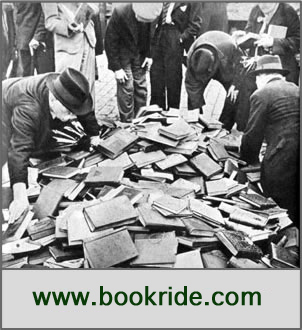
I heard of a third copy going through CSK at the sale of the library of Lytton Strachey’s sometime lover Roger Senhouse (1899-1970) who was a translator of Colette and a partner in the publishing business Secker and Warburg. Interestingly that was a famously botched sale from the 'chinless' of Christies-- almost all the books were in tea chests and contained incredible Bloomsbury rariana, signed Virginias, Hogarth & Omega Press, scarce Continental presses and a batch of presentation George Orwells. A lot of the books went for very little and ended up with the celebrated and unlettered bookseller George Jefferys, who knocked them out on the pavement at Farringdon Road - pretty much as you see in our signature photo top corner of this web page. A friend who got a few chests was surprised when Cyril Connolly turned up at his premises (with entourage) wanting to buy from the collection. 35 years later you still see Senhouse books with his small neat pencilled ownership signature. He had the admirable habit of compiling indexes in books where the dastardly publisher had been too lazy to include one.


The photo above shows the beautiful Emma Thompson and Jonathan Pryce in 'Carrington' the best of Bloomsbury movies (most are poorish vide 'The Hours' and 'Mrs Dalloway') - Pryce was an exceptional Strachey and Rufus Sewell a fiery Mark Gertler. Sample from the script - Gertler is very pissed off that Carrington is in love with Strachey:

Mark Gertler: Haven't you any self-respect?
Dora Carrington: Not much.
Mark Gertler: But he's a disgusting pervert!
Dora Carrington: You always have to put up with something.

The above dialogue brings to mind the lines at the end of 'Some Like it Hot':
Jerry: But you don't understand, Osgood!
[Pulls of wig]
Jerry: I'm a man!
Osgood: Well, nobody's perfect!

VALUE? I have had 2 copies in 30 years both from old Bloomsbury types. This generation have now almost all died. In a list of Leonard and Virginia Woolf's own library (4000 books at Washington State) it is noted they had 2 copies, seemingly both bound up by Virginia. The book is preceded in the Lytton Strachey canon by Prolusiones Academicae (1902?) which is hideously scarce and probably slight. 'Euphrosyne' is a true sleeper and I feel bad about awakening it, my excuse is that it is too uncommon to have any real currency, also there are other Bloomsbury sleepers of greater value that can remain, forever, sound asleep. Think £1500 and above. (pic below Virginia Woolf and Angelica Garnett - her sister Vanessa Bell's daughter by Duncan Grant.)


COLLECTING BLOOMSBURIANA. There are some of the opinion that the entire coterie did not produce one masterpiece, some point to Virginia Woolf as a proven writer of world class books. Some talk of Maynard Keynes as a genius, certainly his name has been invoked enough in the current slump. Huge claims can be made for E.M. Forster. A fellow dealer opines that Bloomsbury collectors are the maddest of the lot. Most would not have been welcome at Charleston or Monks House.

OUTLOOK? The Bloomsbury industry is mostly about gossip, drama and romance --Vita and Virgina, Vita and Harold, Vita and Violet, Dora and Lytton, Vanessa and Clive, Vanessa and Duncan and then there's bad boy Bunny Garnett...tangled relationships, posh backgrounds, country estates, the pursuit of sexual freedom, the desire to shock the bourgeois, high intellectual ideals - they will be collected until the Kingdom comes, prices already high, will probably rise...

Five types of Book Dealer


The indigent bookseller. A low key bookscout of no fixed abode. Sleeps in the back of his car or in flyblown motels or occasionally on fellow dealers floors or in lockups. His car is a disgrace but just passes legal tests. Keeps his books in a storage unit (U Storage) where he is perpetually in danger of missing his rent. There is always a character like this in John Dunning's excellent bibliomysteries and he normally comes to a sticky end. Occasionally he finds a sleeper which he runs at a quarter of its value or persuades a fellow dealer to put in on Ebay and go halves. Invariably male, mostly American where the climate is more conducive to being a bum. He has, as Groucho would say, 'worked his way up from nothing to a state of extreme poverty.'

The grandiose bookseller. Has a fine mansion downtown or a showoff country estate (seldom both, booksellers are not hedge fund managers.) He may have horses, pools, tennis courts, a taste for antiques, vintage wines, brand new luxury cars and exotic travel. Because bookselling does not generally support this lifestyle he quite often goes broke and all his books are sold off in auction at sobering prices.

The humble bookseller. Sometimes known as the 'mere man' (at one time we had bought a rather prestigious collection full of fine bindings, literary first editions and scholarly works and a dealer seeing these asked 'Do you have anything for the mere man.') He does small provincial fairs has an eye for a good military, naval or transport books--he will sometimes plump for Noddy, Ladybirds or Observer books or New Nats. He tends to sell his good books to specialists but has now discovered the internet and is perplexed as to pricing--if he puts the book too low it will go like a bullet but if he charges what everybody else is charging the book never sells. He knows books that will sell well at £10 on Ebay, has a roof over his head, a car that is properly insured and taxed and generally enjoys the chase. He is not to be confused with his close relation see 'the teabag bookseller.'

The pompous bookseller. Has a broad knowledge of the ancient world, can quote Shakespeare and even Dante (in Italian). Sometimes went to Oxford or Harvard and will remind you every four minutes. When classical music is playing he immediately names the piece and may even start to conduct it. His books are priced within an inch of their lives but he will give deep discounts to anyone half interested; such is his bravado, chutzpah and charisma he can usually buy well from estates, fellow dealers and widows. Usually somewhere along the line he has had an amazing buy that made him take himself pretty seriously or he may have inherited a large sum from a doting aunt. He seldom goes broke and as Oscar put it -'he has no enemies, but is intensely disliked by his friends.'

The raffish hustler. Another almost exclusively male type. A bookdealer with a colourful, sometimes dark past. Born in a mansion or from a semi in Barnet, he may have been in rock music or owned a night club, sometimes there is a spell in rehab or an over acquaintaince with the bottle. Broken marriages, bankruptcy and banishment are not unknown. Possessed of fiendish intuition, deep and recondite knowledge he wades through the world of of old books finding great treasures but tends to squander the money on pleasure or occasionally takes a big loss on books that turned out wrong. He is optimistic by nature. Keith Richard is sometimes mentioned but this guy tends to be wirier and possible a little wiser but never as wealthy. When on the skids fellow dealers or wealthy collectors bail him out and he is never down for long. He can sometimes hustle himself to near the top of the trade, relies heavily on luck and serendipity and is much admired by other dealers who lack his bravura. He is closer to the indigent type and never pompous...