RARE BOOK GUIDE - THE RUNNERS, THE RIDERS & THE ODDS

25 March 2009

'Literary treasures uncovered by the recession...' (Daily Telegraph)


Tougher times are boosting sales at second-hand bookshops, says Peter Robins.

This is an article by the excellent Peter Robins who interviewed me by phone -it came out in early March in The Telegraph (British broadsheet daily newspaper sometimes called 'The Torygraph' by Lord Snooty and his chums at Private Eye.) Frankly this thing of bookshops booming is erroneous, they are doing well compared to sellers of carpets or Jaguars, but some shops are hurting pretty bad and turnover very much depends on what books you have bought.

Through a combination of sheer luck, dedicated and unctuous networking and using various cunning stratagems learned from old and vanished booksellers, we have this year bought some exciting libraries, mostly devoid of dogs. Such is this 'bookshops are booming' thing in the news that an optimist phoned me up wanting to sell some books and said something along the lines of 'I imagine you can pay a bit more than usual because books are much needed in these difficult times.' The odd thing is he was being deadly serious.

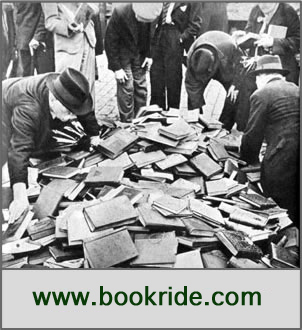
Above is the photo they used with the byline 'Keen: a browser at Any Amount of Books in Charing Cross Photo: Paul Grover.' Here is part of the article...
This has not been a good decade in which to own a second-hand bookshop, with discounted new books at supermarkets, growing competition online and from charity shops, and the rising rents of a long property boom. Now, however, there is something that, squinting hard, you might just describe as a ray of sunshine. It’s what the rest of us call a recession.
At Scarthin Books, a rambling independent shop with new and second-hand books in Cromford, Derbyshire, Dave Mitchell has grown used to things running against him. He says business was expanding nicely until about 1999. After that, with great effort, it has been steady. But this year his January sale brought its best results since 2003; “not back to the glory days before Amazon and Tesco started eating into sales, but certainly no 'downturn’ on the last few years”.
 
Mitchell does not separate his second-hand and new sales, but he sees two divergent trends in the second-hand trade as a whole. “For the traditional antiquarian shops, business is appalling,” he says. “But the big browsing shops are booming.” Other reports seem to bear him out. Barter Books in Alnwick, Northumberland, and Richard Booth’s Books in Hay-on-Wye – heavyweight “big browsing” bookshops – each reported a strong 2008.
Some gains at the cost-conscious end of the market are also visible at Any Amount of Books in Charing Cross Road, London, where Nigel Burwood offers a bargain basement, discounted review copies and an eye for rarities that he also shows off at his blog, Bookride.com. “There are more people looking for savings, bargain-hunters and bottom-feeders,” he says. “And they are all very welcome.” He hopes that the weak property market might reduce rent pressures.
At the same time, he is coping with the other side of the equation: buyers for books with three or four-figure price tags have grown “very cautious”. “In my experience,” he says, “the rich shut their wallets just the same as the poor, if not more quickly.” And dealers seem to be buying much less from one another.
But there is one potential gain from the recession even for sellers of more expensive books. A weak pound brings eager internet custom from abroad.....For many people, charity shops have become an important source of second-hand books. Oxfam considers itself to be “the largest high-street retailer of second-hand books in Europe”; it has more than 100 shops dedicated to books or to books and music, and its online bookstore has about 50,000 listings. Barney Tallack, its deputy trading director, does not detect a recession-related sales surge “yet”. “But we are seeing sales levels ahead of last year,” he says, “which in the current context could be considered good news.” The recession is also a chance for Oxfam to find new shops.
Traditional booksellers are often sceptical about Oxfam, and will tell you that its prices can be higher than theirs. But Tallack does not see his bookshops taking trade away from traditional dealers – they bring more buyers into a given area, he argues – and says its prices are set by volunteers with local knowledge and specialist expertise.
But the character of a traditional second-hand shop is impossible to replace. It’s a question of serendipity. There is no online equivalent of picking up a battered-looking tome about “The Men of the Sixties” and discovering, on turning to the title page, that these aremen of the 1860s. Then there’s community. “The second-hand bookshop is the last oasis for eccentrics and outsiders and general antinomians,” says Burwood.
At the bargain end of the market, traditional shops can still compete on price. Although AbeBooks is starting to experiment with free-postage offers, a 50p or £1 book online is still frequently more expensive than a £2 or £2.50 book in a shop once delivery is included.
“We do think that we undercut the net by the time you’ve taken that kind of thing into account,” says Mitchell. In a recession, that could be a critical advantage. For full article click here.

Funny to see the word 'antinomian' in the Telegraph. We use it as workplace slang for unorthodox religious books and their collectors- occult, new age, Zen, spiritualists, Sufi, millenniarists, diabolists, Wiccan, pagan etc., Some hardbitten dealers refer to their New Age books as the 'touchy feely' section. In fact New Age is not the great seller that it was--in the field of religious books it is the scholalrly and academic tomes that sells and, of course, the occult (the blacker the better.)

In the Age of Dawkins and Hichens it is good to see these sections thriving. An Antinomian, as every schoolboy knows, is one who denies the obligatoriness of moral law, one who believes that Christians are emancipated by the gospel from the obligation to keep the moral law, faith alone being necessary.' (Chambers.) Ed Sanders at one point calls Charles Manson an antinomian--in the sense of one who invents his own religion. (Pic left- a late work by Austin Osman Spare- a drawing from memory of Crowley done in 1955.)

20 March 2009

The Road to Oxiana (revisited)


Robert Byron. THE ROAD TO OXIANA. Macmillan, London 1937.

Current Selling Prices
$1500-$3000  /£750-£2000
 

MODERN FIRST EDITION / TRAVEL WRITING
This is a redoing of a posting from November 2007 with the values edited and some new info on the 'Byronic character' mostly from D J Taylor's masterpiece of research 'BRIGHT YOUNG PEOPLE; The Rise and Fall of a Generation 1918 - 1940.' Robert Byron greatest travel writer of his day,  aesthete and leading member of the Brideshead generation and connoisseur of coloured architecture. The Road to Oxiana, describes his journey to Persia and Afghanistan in 1933-34. 20 years ago the book was known to a few collectors only, although RB pretty much invented the modern literary travel book. Paul Fussell insists that "what Ulysses is to the novel and what The Waste Land is to poetry", Byrons book is to travel writing. 
 After it appeared in a catalogue for £500 and sold, one over zealous dealer travelled the length of Britain looking for it  (they had  quite a few shops back then) and asked every seller if he had a copy. It is not an especially rare 'rare book' so he found a few. The book was then wide awake and later started to achieve spectacular results in auction and is no longer fun unless you find it at the bottom of a tea chest in a sale that somehow has eluded being listed on the web. Trouble is they are  all listed and they don't use tea chests anymore, and even the dimmest and most chinless book auctioneer has heard of the book.

Robert Byron is referred to (by Philip Hensher) as a 'High priest of Camp' mainly from the set he ran with at Oxford (Hypocrites Club etc.,) His taste, sometimes called kitsch,  was  for things that others at the time disdained - like Byzantine art and Persian architecture, Georgian buildings, Victoriana etc., He was said to resemble Queen Victoria and occasionally dressed up as her for parties. He never gave up his youthful enthusiasms or his desire to shock; he lost friends over his insistence from the start that Hitler would have to be fought, and that the Munich agreement was a disgrace. He did not get on with Evelyn Waugh.  He was surprisingly rugged, his journey into Tibet in 1929, for instance, was by any standards extremely harrowing and physically taxing. This is covered in a useful work 'First Russia, Then Tibet' (Macmillan 1933)--not uncommon but can command a £100 note and a lot more in the jacket. His signature  is highly uncommon, earlier this year we bought a couple of presentation copies --including one of his first book 'Europe in the Looking-Glass. Reflections of a Motor Drive from Grimsby to Athens' (1926). We described it thus:
'Signed presentation from the author --'Mrs.Harrod - if only I had seen her more- Robert Byron.' This is Lady Wilhelmine 'Billa' Harrod who was married to the economist Roy Harrod and co - authored the Shell Guide to Norfolk with  John Betjeman, to whom she had been briefly engaged. In 1937 as Billa Cresswell she had been the secretary and only employee of the Georgian Group with which Byron was passionately involved; he said of her '...she would make a wonderful agitator.'  On her marriage to Roy Harrod in 1938 she gave up the job and this inscription obviously refers to that. Billa Harrod continued to agitate for the saving of beautiful buildings all her long life, Robert Byron was killed in the war in 1941.'
It was not a nice copy but went to a collector fairly smartly at £800.

VALUE?  A copy of 'Oxiana' in a decent jacket made £1400 + premium in 2004.  A fairly decent copy is on sale as we speak at £2000. The book may (apres le deluge) go up gently if modern travel writing becomes more collected. Recent auction records for less than great copies have been well under a £1000. The great proponent of Byron was Bruce Chatwin who has turned him into something of a cult. Meanwhile Chatwin's own 'Oxiana',  his first book 'In Patagonia' has declined in value--at one point it was knocking on a grand but can now be found for less than £500 'fine/fine' -- there are  too many about and it is possible that he is less admired than he was in the 1990s. There are several other Robert Byron rarities and 'sleepers' that I might address at some point...in fact the main one is 'Innocence and Design', a 1935 novel he co-wrote with Christopher Sykes (under the name Richard Waughburton). Interestingly the Macmillan's clothbinding is a pastiche of the patterned cloth often to be found on nineteenth century Oriental travelogues. I once found a copy in the one pound book room of a Suffolk mansion--the jacket was rubbed but it was quickly converted into a £500 note. Now worth twice that for sharp jacketed copies.

  The 'Byronic Manner'.  Waugh was known as being difficult, prickly and abrasive but in the bastard stakes he was a household tabbycat compared to Byron. Basically a rageaholic - as DJ Taylor notes 'a railway journey invariably meant a quarrel with the guard or an altercation at the ticket office.' At least once he was arrested for 'insulting behaviour' (trouble in a cinema queue- fined 19/6). As DJT demonstrates the BYT's were an insolent and troublesome bunch and he was their star performer, a supreme put down artist, master of the 'sarcastic backhander,  the thinly veiled threat...' Vide his treatment of Harry Melville. Melville was well known to the BYTs although he was well into his anecdotage--'last of the professional diners out' (Osbert Lancaster) he had been a friend of Wilde and had known Proust- he embodied all the 'fabled sophistication of the 1890s.' During one of the veteran raconteur's reminiscences Byron is said to have shouted at him 'Can't you shut up, you hideous old relic of the Victorian age.'

On his trip to Albania his travelling companion observed that he 'spent most of the time cursing. He cursed almost everybody who did not speak English, sometime violently, but more often in a pleasant conversational monotone, as though he were discoursing on the beauty of the countryside.' Oddly enough Chatwin was also had his farouche side and could resort to force if countered; Byron was keen on threats of legal action especially against editors who dared to propose changes to his text.

15 March 2009

Martin Parr. Bad Weather, 1982 + the world of the Photobook (according to Parr).


Martin Parr. Bad Weather. Zwemmer, London 1982.

PHOTOGRAPHY
A mere 62 pages in soft wraps with 54 b/w photos. Text includes a commentary by cult status weatherman Michael Fish. Parr is a highly collected and gifted Brit snapper (born 1952) who at some point was inducted into Magnum to the disgust of vieux humbug Cartier Bresson who described him as being from "a different solar system." MP is also responsible for the droll collections of 'boring' postcards, now up to 3 books -they have practically become a franchise. Parr has a 'whim of iron' as Powell said of Betjeman. Both top photos from this superb book.

Current Selling Prices
$250-$450 / £200-£350


VALUE? Copies on web are mostly £200 +, seldom less. Signed copies are more expensive but Parr is the Edward Heath of signed photo books, signatures add little. 'Bad Weather' is the kind of book you might find at a boot sale under a cold British sky for buggerall - it looks like nothing. Its value has stayed at this level for 3 years now. One prominent dealer says of Parr '[his] influence in contemporary British photography is unparalleled, but it is his contribution to the understanding and importance of photographic literature that may be his most profound legacy.' They are talking about his magisterial 2 vol 'The Photobook' which sits on a shelf beside me as I type.


Looking at the 'photobooks' I have covered in the last 3 years there has been, in most cases, an ineluctable rise in price. Possibly this is now stalling but so far it is holding its own. One caveat--in my experience when you are selling photobooks on the net it is often hard to actually get anywhere near the supposed value of these books unless you have very sharp copies of known rarities. Many photobook collectors are not burdened with money and need serious discounts and even time to pay; the core of richer buyers (often NY based) are probably feeling less cushy than in 2007, a few may even have been wiped out. Also it is safe to say that many modestly pitched items sell rapidly and silently against the higher prices; some dealers actually need money coming in...

Here are some notes:-
Carnival Strippers by Susan Meiselas. (1976)
Was $600 about 2 years ago now at least $800 (up circa 30%)

Sumo. Helmut Newton. (1999)
Was $8500 late 2007. One of 10,000 signed and numbered by the photographer. A book so large that it comes with its own metal folding stand, engraved with the author's name. Still goes for about the same money, or as much as 25% less due to the state of the dollar. Some surrealists want $14000 and even $25000. Dream on!

David Bailey's Book of Pin-Ups, 1965. Sixties flared trouser cockney sparrow pointedly ignored by Parr ( they have probably had bidding wars as Bailey is also a great photo collector.) Was $7500 in mid 2007. A copy made $7000 mid 2008 but it had made $14000 in 2005. Probably standing still in price, not esp rare but hard to find complete (36 pics) and in good nick.

P.H. Emerson. Marsh Leaves. 1895.
$5000 mid 2007. Not really tested since but an unpleasant copy on ABE at slightly more than this seems to have sold in late 2008 and would now expect a decent copy to nudge into five figures at auction (with the juice etc.,) One of the greats.

The Book of Bread. 1903
Was $800 early 2007. 2 copies on ABE now -one at $3000 and one not so nice at $4000. Freakish book of which the mighty Parr wrote "one of the humblest, yet most essential of objects is catalogued as precisely, regorously and objectively as any work by a 1980s Conceptual artist" Not a book to buy at these levels but to find somewhere overlooked (in the cookery section.) Probably sells regularly at half these prices. It's appeal is essentially whimsical. 300% increase.

Robert Frank. The Americans. (1959)
$7000 early 2007. In 2008 it made $15K (fine in slightly used d/w) and $32K (F/NF) and was bought in at $3k in an unpleasant jacket. All at Swann NY except the $32K which was at Christie's NY where it was described as 'A FINE COPY OF FRANK'S MASTERPIECE, and rare in this condition. (Quotes Parr) "The most renowned photobook of all... none has been more memorable, more influential, nor more fully realized... it changed the face of photography in the documentary mode".

El Morocco Family Album. Zerbe, 1937.
$1000 in early 2007. Bad copies now at $1100 better at $1700, a chancer at Amazon wants $2400. Society photography, social document tend to be beneath the Parr radar, below Parr- as it were.

Takashi Homma. Tokyo Suburbia, 1998.
$850 early 2007. Can now be had at under $700 and from Japan at slightly less than $600 as 'supply and demand' takes over. His 'Babyland' from 1995 can be had for less than $300.


Bruce Weber. Bear Pond, 1990.
Was $400 early 2007.
Still $400 and on some days less. Parr still has no time for Weber.

A Wonderful Time. Slim Aarons, 1974.
Was $250 early 2007. About the same price now, sometimes a bit more for F/F copies, suspect they occasionally go cheap on Ebay. Pictures of the very rich enjoying themselves could now be a little de trop for some. In Parr - he normally eschews social snappers. (Image below)


Ballet. 104 Photographs. Brodovitch, 1945.
Legendary photobook. $3500 in early 2007. Early 2008 a superior copy went through Ebay at $3500 or a bit more, rather used copy on ABE now at $3950, carriage trade dealer wants an unfriendly $9500 for a very nice example, a similar copy can be had at $4950 and top of the pile a midwest Video shop wants $11000 for the least good of the 4 copies for sale. As often happens the worst copy is the dearest (the mad hatter principle.) Book has gone ahead by as much as 60% in 2 years but is proving less scarce than was thought. "...One of the most cinematic and dynamic photobooks ever published..." (Parr)

Outlook? . Not an area I would like to wade into with credit cards flying right now, but there may be further life in the market especially with the incunabula of photo and proven geniuses like Emerson and Sander. The problem with most photobooks is you don't get much for your money. Their value derives from their iconic significance, sometimes $3000 gets you a small thin glossy book with a few printed b/w snaps. As one wag once observed (paraphrasing Veblen) 'modern art is a rich man's way of making poor people feel stupid.' So in this spirit the fact of a book looking insubstantial and even insignificant is no bar to its being valuable--in fact it helps. The 'mere man' cannot possibly appreciate this stuff. You demonstrate wealth and status by possessing it and recognising its true value. This may change - as it has before.

09 March 2009

A. E. Waite / Divination / Bibliomancy


BIBLIOMANCY

Found in A.E. Waite's 'Occult Sciences' (1891) between Belomancy and Capnomancy (divination by smoke) this method of detecting witches and sorcerers and also using a Bible for prediction etc., Belomancy, by the way, is divination by arrows...
"Occasionally the forms of divination exceeded the bounds of superstition, and passed into the region of frantic madness. There was a short way the sorcerers which was probably the most potent discoverer of witchcraft which any ingenuity could devise. A large Bible was deposited on one side of a pair of weighing scales. The person suspected of magical practices was set on the opposite side. If he outweighed the Bible he was innocent; in the other case, he was held guilty. In the days of this mystical weighing and measuring, the scales may be truly said to have fallen from the eyes of a bewizarded generation, and to have revealed " sorcery and enchantment everywhere."

Bibliomancy, however, included a more harmless practice, and one of an exceedingly simple character. This was the opening of the Bible with a golden pin, and drawing an omen from the first passage which presented itself. Books like the Scriptures, the "Following of Christ," and similar works, abound in suggestive and pertinent passages which all men may apply to temporal affairs, but declares that he had recourse to it in all cases of spiritual difficulty. The appeal to chance is, however, essentially superstitious.
By the way A. E. Waite is a useful writer to find books by but not in the same league at all as the Great Beast. His most expensive work is likely to be his first 'An Ode to Astronomy and Other Poems (100 copies, thought to be 1877) or his second 'A Lyric to the Fairyland.' R B Russell values these at £3000 and £2000 respectively, possibly taking the price from the air. His rarest is undoubtedly 'The House of Hidden Light' written with Arthur Machen and published in 1904 in 3 copies. Russell has this at £1500. The 2 authors are pictured below, Machen on the left (uncharacteristically.)


Waite's work was mainly on the occult and mystical (he was Grand Master of the Golden Dawn in 1903) and, although one sees some of these books at giddy prices (£1000+) they are seldom worth it and he is hard to sell at ambitious prices. Signed copies are often seen marked up as if he was Yeats or the Beast but are not especially uncommon and do not double the price. One of his works on the web 'The History of Magic (1913, translated from Eliphas Levi) turns out be Aleister Crowley's copy, signed by him and with his extensive (and scornful) annotations throughout. Crowley and Waite had an acrimonious falling out, a bit in the Naipaul /Theroux or Beaton / Waugh mode + he claimed to be the reincarnation of Eliphas Levi, and many of his own writings were inspired by the French occult author and Mage (pic left). Priced at the palindromic and "beasty" price of $11666.11. Toppish in price but not completely unthinkable, although a bit worn and shaken with the odour of cigarette smoke (possibly the strong shag that Crowley liked) it had also belonged to Peter Warlock the composer with his ownership signature dated 1916. Crowley punters are unlikely to be put off by the odour of baccy but it could be a good bargaining point. A distinguished and important association deftly catalogued by the mighty Powell's of Portland.

Never been to Powells --I imagine it is like the Strand Bookshop in New York but on a gargantuan scale. I would like to go there. Martin Stone, uberscout and lover of fine books, was unimpressed by the condition of the good stuff there when he passed through with the good Baxter on their legendary road trip. He also did not dig their slightly anti dealer vibe. You sometimes get this in bookshops- they cannot appreciate that dealers are often among their best customers. All I know is when I have ordered from them they pack the books lightly-- belonging to the majority school who believe you merely have to put a book in a bag to send it; bubble, packaging and protection not needed (allright, some dealers go too far the other way with 7 layers of hurricane proof wrapping.) Apart from all that they are one of the world's top shops, with more books than the Bodleian, the tower of Babel and the library of Babylon.

06 March 2009

A Bookseller Poet


Bookseller poets are not especially scarce or rare but they seldom write about bookselling. Joan Barton was a bookseller. She was also an accomplished poet somewhat in the style of Larkin and Betjeman but with a lyric tenderness entirely her own. She was born in England in 1908 and died in 1988. When illness curtailed her studies at Bristol University she began her working life as a bookseller. Later she was employed by the BBC and by the British Council where she was a director of a department during World War 2.

In 1947 she and her partner Barbara Watson started the White Horse Bookshop in Marlborough, but after twenty years sold it and moved to Salisbury, where they issued catalogues of modern first editions and children's books from their home. She reviewed for the New Statesman and contributed poems to many magazines including WAVE. Early in her writing life she owed much to the encouragement of Walter de la Mare. In her final years she had struggled with failing sight but she gained some recognition through a feature on US radio, a published interview and in 1979 an article on her in the American Journal Women in Literature. She was also included in several anthologies including Poetry Book Society Christmas Supplement, 1974 (ed. Philip Larkin) and the Oxford Book of Twentieth Century Verse.

She published about 6 little collections of poetry some of which can be bought online for modest sums, amongst them was a poem that referred to her work. There is another about a house call, a beautiful poignant poem which I shall air at a later date--meanwhile, take it away Joan :-

LOT 304: VARIOUS BOOKS.

There are always lives
Left between the leaves
Scattering as I dust
The honeymoon edelweiss
Pressed ferns from prayer-books
Seed lists and hints on puddings
Deprecatory letters from old cousins
Proposing to come for Easter
And always clouded negatives
The ghost dogs in the vanishing gardens:
Fading ephemera of non-events,
Whoever owned it
(Dead or cut adrift or homeless in a home)
Nothing to me, a number, or if a name
Then meaningless,
Yet always as I touch a current flows,
The poles connect, the wards latch into place,
A life extends me-
Love-hate; grief; faith; wonder;
Tenderness.

From 'The Mistress'. Sonus Press, Hull 1972.

04 March 2009

Carnival Strippers by Susan Meiselas.


Susan Meiselas. CARNIVAL STRIPPERS. Farrar, Straus, Giroux, NY 1976.

PHOTOGRAPHY.
Desirable photo book, not uncommon but seldom shows up as a first, jacketed hard back. Cover is silver. In the early 1970s Meiselas travelled with some small New England and Southern "Girl Shows", including the Club Flamingo, the Star and Garter & the Club 17. Pictures and text from 100+ hours of interviews. Not a salacious book, somewhat noir and poignant, some photos are said to shock. A journey into the darker side of American life. A great photographer, she won the Robert Capa Gold Medal, the Leica medal for excellence, and The Photojournalist of the Year etc., Her book 'Nicaragua' is in Parr's definitive 'The Photobook' and this book is in in Andrew Roth's Book of 101 Books: Seminal Photographic Books of the Twentieth Century.'

Current Selling Prices
$800-$1200 / £500-£800


VALUE? Hardback copies in jackets are avaiable at $1000+ but are attainable at less, one hopeful wanted $750 for the paperback, but it can be found at under $200. Kind of book you might find in a slightly curled jacket at a flea market (priced at $10 for its sleaze factor) if you got there at dawn. It has gone up in value over the last 2 years as a hardback. Hard to know whether photobooks are still a good investment bought at these levels. Their values, which crashed in the 1980s have gone up and up and a correction is almost inevitable especially in a market that is otherwise troubled. Will examine this question further as I have records of values of photobooks from 2/3 years ago.

A re-issue appeared in 2003 which has a CD of some of her interviews and added new pix - it can be bought signed at $150 or less. The publishers (Whitney Museum of American Art in association with Steidl Verlag of Göttingen Germany) say this of it:
"From 1972 to 1975, Susan Meiselas spent her summers photographing and interviewing women who performed striptease for small town carnivals in New England, Pennsylvania, and South Carolina. As she followed the girl shows from town to town, she portrayed the dancers on stage and off, photographing their public performances as well as their private lives. She also taped interviews with the dancers, their boyfriends, the show managers, and paying customers. Meiselas's frank description of the lives of these women brought a hidden world to public attention. Produced during the early years of the women's movement, Carnival Strippers reflects the struggle for identity and self-esteem that characterized a complex era of change....essays by Sylvia Wolf and Deirdre English reflect on the importance of this body of work within the history of photography and the history of feminism."

01 March 2009

Booksellers and the Big Crunch 2


More uninformed and subjective notes on how the recession is affecting the trade in rare and used books. It's funny but as a retailer with a shop in the dead centre of London I am now continually asked by concerned friends 'How is it going?' Like someone inquiring of the health of a patient with a long, lingering and potentially fatal illness. I usually reply something on the lines of 'mustn't grumble' 'keeping my head above water' or 'not too bad.' It is not a good idea if it is going well to boast about it (apart from inviting the wrath of the Gods, it tends to annoy) and if it is going badly you don't want to bring people down, or accelerate the process by spreading the news. Considering we are in the middle of the worst financial crisis since the South Sea Bubble it is actually going pretty much as normal, possibly with slightly more poor days than 2007 and 2008. Confidence is generally low, especially among American dealers, and there is talk of a coming serious 'buyer's market' with sellers overwhelmed with 'borassic'* collectors trying to raise money. If I see hoards of impecunious book collectors advancing on Charing Cross I will let you know. The last time it happened was when the shop on the corner took a large 'books bought' ad out in the Daily Telegraph - but that's another story...

Even the internet is still just about holding up. My theory is that its use for retail is still growing fast and that is making up for slower sales -two and a half paces forward two and a quarter paces back.

Some notes.

1. Reports are coming through that 2009 book auction results are 30% down on the first two months of 2008. A difficult one to call as it depends on the quality of goods offered and it is likely that owners are holding back from consigning really good books. If I hear of further drops I shall start going more frequently, but lately I have found the process of viewing, bidding and clearing tiresome.

2. A high end American dealer reports (in an interview) that nowadays 3,4,5 days can go by without him getting a single internet order. He has 8000 books on the web and should sell about 4 a day (1 per 2000 per day). It used to be 1 per 1000 per day but has now migrated to 1 per 2 thousand and may be heading towards 1 per 2500. This is very general - if you have cheap books well selected and attractively priced and you are on Amazon, Alibris and ABE it can be much higher and they will know you well at the post office. Looking at this genial dealers stock online I found that even for relatively common books he is usually the most expensive - this might explain poor sales. Confronted with a list of books in similar condition the buyer chooses from the least expensive end of the list - a strange, perverse quirk and hard to explain.

3. I read an article about how to survive the recession (Harvard Business Journal). It used the Muhammad Ali - Foreman fight 'The Rumble in the Jungle' as an analogy. Ali apparently won by being able to absorb more punishment than his opponent and by being more agile. The Harvard bloke said these are the 2 qualities needed right now for financial survival - absorption and agility. Sounds fair enough. I have written the two words on a card and stuck it on the mirror so I see them every morning. Got to remember that absorption does not mean being able to absorb a ton of bad books. These are best avoided with some clever foot work. Basically you have to box clever...

4. I was in a shop the other day in a town which I shall call Seatown, a name out of 'Mass Observation.' The shop, not large, had plenty of punters and in the half hour I was there the guy took about a £100 and I then spent £65 which he rounded down to £50. The prices were very modest but the stock was very good and well chosen and there was what appeared to be plenty more of it coming out. The secret is that Seatownman has always been modest in his pricing and hasn't suddenly turned into a decent type after being a bastard all through the boom years. He is well known throughout the large extended coastal community, turns no one away, listens to the tales of the 'talking wounded', the bores and bullshitters -even makes a cup of tea for some of them. He is not going to end up with a Camargue or a Cayenne or a Cadillac but he is also not going to go broke and can buy his round, even take the occasional extended holiday.

5. There are no green shoots visible but people are now getting used to the recession. In the initial shock people zipped their wallets tight, went home and avoided non essential shops. That may be over, unless like an earthquake, there are further shocks...

*borassic = financially embarrassed, broke --rhyming slang where borassic lint = 'skint' = broke.

28 February 2009

Zang Tumb Tuuum! (1914)


Filippo Tommaso Marinetti. ZANG TUMB TUUM (Adrianopoli, Ottobre 1912 : Parole in LibertĂ .) Poesia, Milan, 1914.

Current Selling Prices
$3000+ /£2000+


SOUND POETRY/ FUTURISM / ARTIST'S BOOK
The kind of book you could theoretically find in the foreign language section of a doltish bookseller ignorant of modern art, poetry and European literature - plenty of chaps like that + the book is not on the net. This might trigger some sort of high pricing response and they might go for something extravagant like $375, a fairly typical bookseller's price for a book that is 'not on net.' Of course it's a marvellous piece of work by the great Italian futurist (alright he was a bit of a fascist) and remarkable for 1914. At 225 pages it is not a pamphlet but not a fat book. The BM lists two sizes 19cms tall and 28 cms tall.

The book had appeared in excerpts in journals between 1912 and 1914 and is one of the very first manifestations of the modernist avant-garde, well before the Cabaret Voltaire bunch launched DADA in 1916 and even the Vorticists and their fabulous puce BLAST manifesto (1914.) In FUTURISM by Caroline Tisdall & Angelo Bozzolla (T & H 1977) they say this of it:-
"[The] masterpiece of Words-in-freedom and of Marinetti’s literary career was the novel ‘Zang Tumb Tuuum’... the story of the siege by the Bulgarians of Turkish Adrianople in the Balkan War, which Marinetti had witnessed as a war reporter. The dynamic rhythms and onomatopoetic possibilities that the new form offered were made even more effective through the revolutionary use of different typefaces, forms and graphic arrangements and sizes that became a distinctive part of Futurism. In ‘Zang Tumb Tuuum; they are used to express an extraordinary range of different moods and speeds, quite apart from the noise and chaos of battle.... Audiences in London, Berlin and Rome alike were bowled over by the tongue-twisting vitality with which Marinetti declaimed ‘Zang Tumb Tuuum.’ As an extended sound poem it stands as one of the monuments of experimental literature, its telegraphic barrage of nouns, colours, exclamations and directions pouring out in the screeching of trains, the rat-a-tat-tat of gunfire, and the clatter of telegraphic messages"
OUTLOOK/VALUE? Futurism was in the doldrums for a while but recent records show some highish prices. An inscribed 'Zang Tumb' in slightly shabby shape made £2600 at Bloomsbury last May, a better inscribed copy sold in 1993 also at Bloomsbury (to a dealer called Gidal) for a paltry £250. Before that the Tate Gallery bought a copy for £65 just 30 years ago (also inscribed-- Marinetti was a great signer.) Meanwhile the chef d'oeuvre of Futurism, albeit after the event (1932) 'Parole in Liberta Futuriste Olfattive Tattili Termiche' sometimes known as 'the tin book' (see below) made $70,000 in 1993 and the BM bought a copy this year for a generous £83000. It consist of 15 thin metal sheets in various colors and will be on display. This price was paid to another institution and rather like collector-to -collector sales may have been toppish especially in these times. 25 years ago it sold for £4000- a sound investment.

Marinetti's 'La Cucina Futurista' (also 1932) is not without interest -full of outlandish ingredients and bizarre combinations. He even dared to attack pasta - he insisted that it induced 'fiacchezza, pessimismo, inattivitĂ  nostalgica e neutralismo' ('lethargy, pessimism, nostalgic inactivity, and neutralism'). This anti - pasta cookbook might also be found in our imaginary doltish bookshop in the cookery section for $10 but it can make $1000 + for smart copies. I have a customer for one...

25 February 2009

Sheridan Le Fanu - the 'Invisible Prince.'


Idly reading Colin Wilson's "The Strength to Dream' this morning I came across his piece on Sheridan Le Fanu. Talking of dreams, I have long dreamed of finding one of his 3 deckers, the nearest I have got to this recently was finding in an island bookshop, practically mint, a first of his posthumous 'Evil Guest' which, when I got it home, sold like a bullet for a monkey (£500).

Some of his 3 deckers can go for the price of a new (and loaded) Lexus. Colin writes that Le Fanu is the only great writer of the supernatural that the UK has ever produced and that his 'Green Tea' is the most convincing ghost story ever written. The curious thing is that Le Fanu actually collected ghost stories himself. I fantasise that somehow the collection stayed together and is to be found in a huge trunk, unclaimed in a Dublin furniture repository. One day, a mere 136 years after its owners demise, they open it, check on Google and email me that it needs shifting a-sap 'for a fair and reasonable price.' Madness.

The great Colin writes that Le Fanu '... spent the day indoors, emerging in the late afternoon to wander round second hand bookshops. looking for ghost stories...' The basis of this is most likely to be A.P. Graves 'A Memoir of Joseph Sheridan Le Fanu.' Graves wrote that after Le Fanu's beloved wife's death he entirely vanished from Dublin society -
'... so entirely that Dublin, always ready with a nickname, dubbed him ‘The Invisible Prince;’ and indeed he was for long almost invisible, except to his family and most familiar friends, unless at odd hours of the evening, when he might occasionally be seen stealing, like the ghost of his former self, between his newspaper office and his home in Merrion Square; sometimes, too, he was to be encountered in an old out-of-the-way bookshop poring over some rare black letter Astrology or Demonology.

To one of these old bookshops he was at one time a pretty frequent visitor, and the bookseller relates how he used to come in and ask with his peculiarly pleasant voice and smile, ‘Any more ghost stories for me, Mr. ——-?’ and how, on a fresh one being handed to him, he would seldom leave the shop until he had looked it through. This taste for the supernatural seems to have grown upon him after his wife’s death, and influenced him so deeply that, had he not been possessed of a deal of shrewd common sense, there might have been danger of his embracing some of the visionary doctrines in which he was so learned. But no! even Spiritualism, to which not a few of his brother novelists succumbed, whilst affording congenial material for our artist of the superhuman to work upon, did not escape his severest satire...'


J. Sheridan Le Fanu (1814 - 1873) died after completing his last novel, strangely bearing the title ‘Willing to Die.’ You might say that in his later years (wait for it) - 'he haunted second hand bookshops...'

24 February 2009

Baedeker Madeira 1939.


'Representatives of most of the hotels come on board and will (for a fee) see to the landing of the luggage. The custom house is near the Cais and the officials are normally very lenient to tourists. Passengers who have not booked rooms should send their luggage to the custom house, land and choose their hotel, and instruct the hotel porter to collect their luggage...*Reid's an hotel de luxe situated on a basalt cliff and commanding fine views, with restaurant (dancing), tennis courts, bathing place and small swimming pool (lift) R 155, L 8, D 10...' (landing at Madeira)

Karl Baedeker. MADEIRA, CANARY ISLANDS, AZORES , WESTERN MOROCCO. Karl Baedeker, Publisher, Leipzig. 1939.

Current Selling Prices
$1200+ /£800+


TRAVEL GUIDES
A wonderful book to find. Not to be confused with the 1934 German language edition which is still valuable but relatively common. The clue is it doesn't look like the familiar blood red soft cloth fat little handbooks, more like a small slim paperback - but the cover is the same shade of red. It is worth so much you could actually pack it in a case and set off to Madeira with it, even take in the lost isles of Atlantis (o/w known as the Azores.) Sell it on return to finance the trip.

I used an old Baedeker in Venice a few years back and not much had changed. For many parts of the world, however, they represent life when, as Waugh put it, 'the going was good.' Looking at KB's Madeira there would now be a greater emphasis on the now highly touristed Canary Islands. Fuerteventura gets you half a page ('most of the island is rough pasture and is grazed mostly by camels') and in Lanzarote, often known as Lanzagrotty, camels abound, a decent white wine is produced and motor cars may be hired to get to Yaiza, where a guide will take you in 3-4 hours to the top of the Montanas del Fuego. That's about it. Things had changed when in this century the unhinged genius Houellebecq wrote of his holiday on the volcanic isle - basically a Rioja fuelled shag-quest. The lovely Canary sland of Gomera, where natives still communicated with 'the old whistling language', ( Silbo) is described as mainly agricultural. Only in the last decade have they put in an airport.

Our copy is catalogued thus:
'...Small 8vo. pp xx, 128. 17 maps, 6 town plans. Original publisher's red illustrated thin card wraps with lighter red linen spine. Sound vg copy with slight handling wear ... Very decent acceptable example of the very rare (some say the rarest) Baedeker. Most copies were said to have been destroyed on a bombing raid on Leipzig in 1945, a few got to the Baedeker's London agents Allen and Unwin and a few to Scribner's in New York just before the war.' £1100.'
The only other time I have had this book was when we cleared 10,000 books from the offices of Allen and Unwin. There were two. We came out top in a 'private treaty' sale organised by Sotheby's. Publisher's file copies are the holy grail although in the case of A & U they kept back all the books of their star author and cash cow JRR Tolkien (also Arthur Waley and Bertrand Russell.)

VALUE? In an piece in the New Yorker 20 years ago they wrote - '... Bernard J. Shapero, the London rare-book dealer, published a Baedeker catalogue in 1989 ...it quoted the rarest Baedeker as "Madeira, Canary Islands, Azores & Western Morocco" (1939) at $:600, followed by "St. Petersburg & Um gebung" (1913) $:500, "Indien" (1914) $:450 and "Russia With Tehran, Port Arthur & Peking" (1914) $:450.' This is still pretty much the case. There are many copies of 'Indien' still available (at a price) a few St Petesburgs and a dozen Russia with Tehran but only two Madeiras -one at £1750. Look out also for 'Lunar Baedeker' by Mina Loy, a modernist poetry work published in Paris by Contact Press, 1923 and worth as much as any red Baedeker. Worth a detour.

OUTLOOK. Probably healthier than most, Baedekers are not really tied to the book market and are collected across the board and in many countries and in several languages. As late as 2005 a man touted a box full of clean Baedekers around the Bay Area looking for buyers, he found none until he got to Moe's - take heart, they can go unnoticed.

22 February 2009

A Book Collection in Hampstead


I have bought quite a few vanfuls of books in Hampstead this century and was intrigued by a piece in a bookseller's memoir entitled "Some Priceless Books In Hampstead". This was from "40 Years in my Bookshop" by Walter C. Spencer (London 1923). Spencer whose dates were possibly 1860-1952 (unknown to Wikipedia, Google, etc.) was a major book seller of his time, a friend of Thomas J. Wise, but at the time of writing presumably ignorant of his darker side (we're talking forgery.) His shop was at 27 New Oxford and he dealt in prints, plate books, bound sets, the Romantics, Americana, first editions of his time (Wilde, Conrad, Galsworthy, etc.). A big Dickens man, popular with visiting American plutocrats like pickle king Henry J. Heinz and numbering among his customers, Sir Henry Irving, Gladstone, George Meredith, Andrew Lang, Gissing, Pater, Swinburne, and Richard Jefferies.

Spencer visited the library of Wise in Hampstead and quotes from Richard Curle's introduction to the catalogue of the Ashley Library - as Wise like to call his ridiculously valuable collection. The catalogue ran to 11 volumes, Wise was exposed as a forger of rare pamphlets in 1934 by biblio sleuths Carter and Pollard. The books went to the British Museum in 1937. Curle, something of a gun for hire in the rare book world, was also the author of several good travel books and works on Conrad who he knew well. He writes:

It seems invidious to pick out for special note any particular books, and yet I cannot forbear to draw attention to certain things of singular rarity and interest in the following short but representative list. 'Welth and Helth,' 1557 (only one other copy known), 'Gammer Gurton's Needle,' 1575 (the earliest English comedy of which any perfect copy is extant), Spenser's 'Faerie Queen,' 1590-6, Nashe's 'Terrors of the Night,' 1594 (only one other copy known, and that a poor one), Lyly's 'Woman in the Moone,' 1597 (only two or three copies known), Dekker's 'Satiro-Mastix,' 1602, Ben Jonson's 'Sejanus,' 1605 (only one other known on large paper : this is a presentation copy), Middleton's 'Roaring Girl,' 1611, Chapman's 'Widdowe's Teares,' 1612, Milton's 'Comus,' 1637 (the finest copy known), Herrick's 'Hesperieds,' 1648 . . . Blake's ' The Gates of Paradise,' 1793 (the only large paper copy known), Byron's 'Fugitive Pieces,' 1806 (one of three known perfect copies), Landor's 'Idyllia,' 1815, Lamb's six separate 'Tales from Shakespeare,' 1807-11 (of none of these booklets are more than two other copies known), Shelley's 'Necessity of Atheism,' 1811 (one other perfect copy known and with a presentation inscription)...."
[Spencer writes] I suspect that a list like the foregoing would take some equalling, but what if we add to it a dozen books, of which Mr. Wise possesses the only known copies in existence ?
"Prior's "Pindarique on His Majesty's Birthday," 1690, Pope's "God's Revenge against Punning," 1716, Gay's "To a Lady on her Passion for Old China," 1725, Landor's "Iambi," 1800, and his "Letters by Calvus," 1814, Coleridge's "Remarks on Sir Robert Peele's Bill," 1818, Byron's " The Irish Avatar," 1821, Fitzgerald's "Translations into Verse," 1829, Tennyson's "The Birth of Arthur," 1868, D. G. Rossetti's "The Streams Secret," 1870, and Swinburne's "Russia, an Ode," 1890.
Mr. Wise's set of Joseph Conrad's publications is a series of gifts from the author, wtih a signed explanatory note on the blank fly-leaf by Mr. Conrad himself...


And so it goes on, pure biblio porn. I suspect some of the latter one-only-known books may have been Wise's own forgeries. The only modern books that I can think of that would trump the above are Ian Fleming's first book-- a slim volume of verse that he rigorously suppressed or Waugh's The World to Come: A Poem in Three Cantos, privately printed 1916 or Corvo's The Attack on St Winefride's Well (only 2 known). Can Hampstead still provide great treasures? As Cadillac Jack would have it : 'Anything can be anywhere.' I have heard that many of the bigger houses are now owned by Russian oligarchs, not known for their literary taste. Times have changed. In the 60s Hampstead was the haunt of cranks, vegetarians and well heeled leftists. Just over 60 years ago a decrepit and malodorous Aleister Crowley could be seen walking down Rosslyn Hill - one of our customers used to see him there when he lived in Hampstead as a teen.

19 February 2009

French Bibliomaniacs (CBS Sunday Morning)

Well worth a watch. One wonders whether the Great Gatsby than John Baxter holds to camera is the real thing, if it is he can take a couple of years off - it was mint. This CBS six minuter also has Martin Stone -a legend in his own lunchtime - and various bouquinistes , wheelers and dealers and some good stuff on French pulps and series noirs........by the way --that's Martin on the left in characteristic pose... amor librorum nos unit...

18 February 2009

Booksellers and the Big Crunch


Having just done the California Book Fair I should be in a position to pontificate about the effect of the crunch on trade. Surprisingly it was fairly reasonable with dealers still buying from one another, something I had feared might be completely curtailed; even the public showed some enthusiasm and produced cash, cards and cheques. True, everybody wanted deeper discounts than ever, anything that was ambitiously priced was ignored unless it was God's own copy, breathtakingly desirable, ballsachingly trendy or in effulgent condition.

Some higher end dealers sold very little but there were also reports of a few very high takes. Ephemera seemed to be doing well, prints less so. Some optimists said during the last recession that the book trade was the last to be affected and the first to recover; this time there have been signs that the more modest and user friendly end of the trade is weathering the storm or even profiting by it. The jury is still out but meanwhile here are some interesting but contradictory lead indicators, straws in the wind (no green shoots though!)...

1. Advert in 'Private Eye' 23 January 2009. "The Eye' is a UK satirical, whistleblowing fortnightly with a large and affluent readership. I found this in the 'Eye Needs' classified ads section which is full of the broke, the needy and the redundant looking for donations. Please help an antiquarian bookshop survive credit crunch 119100 01057770. The figures are bank account details in case you are minded to pony up. Not a good sign at all...

2. Thrift shops (charity shops) are reporting higher turnovers-- as much as 10% over last year. Given the fact that in the UK many charity shops charge more for their books than secondhand shops this is a hard one to interpret, but at least the money is going to good causes and is not being wasted by booksellers on Volvos, Real Ale, fine wines, single malts, bibliography, corduroy jackets and Apples etc.,

3. Article in 'The Daily Telegraph' 10 January 2009 - Frugal readers give second-hand bookshops a lift. The thrust of the article was that booksellers had a bumper year in 2008 'as cost-conscious readers cut back on buying new titles.' One shop, Barter Books in Northumberland, reported a 10% rise and Richard Booth in Hay reports an 'excellent year.' (One caveat to bear in mind is that turnover in second hand bookshops very much depends on the quality of books bought; I know of a seller who took £40K in 2007 and £150K in 2008 because he hit a stunning collection in his area, if the economy had been more buoyant he could have taken more.) Booth even supplies a slightly risible list of the Top Ten Used Books:

1. Kilvert's Diary 1870-1879, by Francis Kilvert
2. On the Black Hill, by Bruce Chatwin
3. Pride and Prejudice, by Jane Austen
4. Self-Sufficiency, by John Seymour
5. The Origin of Species, by Charles Darwin
6. The Famous Five, by Enid Blyton
7. The Mabinogion, translated by Lady Charlotte Guest
8. To Kill a Mockingbird, by Harper Lee
9. Food for Free, by Richard Mabey
10. On the Road, by Jack Kerouac
Given the randomness of book buying by dealers such lists are going to be site specific, subjective and highly unreliable but they may have some significance. King Richard's list has a Welsh bias. Our top seller is '84 Charing Cross Road', when we can get copies (£1 offered for clean examples.) At the bottom I append US giant Powell's 'Top Ten Used Books' ** list which reflects more American concerns. A spokesperson at Booth's said "We are having a great year. Despite the downturn, sales are up significantly. There are a number of factors. We are selling a lot more on the internet, and I think people are wanting to save money. They are probably not buying new books so much so they are turning to second-hand books instead." Good, encouraging stuff but alot of this info comes from earlier in 2008 before the recession really started to bite... to be continued with other factoids and news of one seaside shop where they are taking money hand over fist...


** POWELL'S TOP TEN USED BOOKS
1. James Bond: The Legacy by John Cork and Bruce Scivally
2. The Sopranos Family Cookbook by Artie Bucco

3. The Blank Slate: The Modern Denial of Human Nature by Steven Pinker
4. A People's History of United States by Howard Zinn 

5. Emily Post's Etiquette by Emily Post

6. Emily Post's Wedding Etiquette by Peggy Post

7. Leadership by Rudolph W. Giuliani 

8. Larousse Gastronomique: The World's Greatest Culinary Encyclopedia by Librarie Larousse

9. When You Ride Alone You Ride with Bin Laden by Bill Maher 

10. What Einstein Told His Cook: Kitchen Science Explained by Robert L. Wolke and Marlene Parrish

16 February 2009

On Collecting Books by Tramps 2


Second and final part of a guest blog by R.M. Healey. No puns about 'came to greeff' by the way, and God Bless the King of Hay for giving the man a square meal. Take it away Robin....

The Canadian Paul Potts is linked to Gawsworth in some people's eyes. Both slept alfresco, though Potts was a lot shabbier and smellier. Friends used to speak of the Potts stink , which accompanied him wherever he went. Of his three or so books Dante Called You Beatrice, which I have mentally subtitled ' the longest whinge in literary history ' ( OK, perhaps Hazlitt's Liber Amoris is another contender ) is the best known. The dozen copies of the very common Readers Union edition in ABE all fetch around £3, but some joker has priced his at £14. Instead of a Sonnet is more difficult to find and a signed copy for £39 in ABE is probably worth a punt.

Both Potts and Gawsworth came to mind quite recently when I thought I spied another homeless writer examining some of the bargain book tables in Cecil Court. I wish I’d hailed him, but I wasn’t sure, and to save possible embarrassment walked away. Francois Greeff was someone I’d interviewed three years before for Mensa Magazine,but for some reason the editor had spiked the piece. But Greeff is an interesting character. After leaving South Africa, where he’d witnessed a close relative being shot in fron of him, he’d escaped for his own physical and mental health to England and after years of living rough ( often is his car ) from Cornwall to Bournemouth, but mainly in London, he finally settled down and started a course at Kingston University, which is where I interviewed him.

If homeless Colin Wilson wrote some of his The Outsider in libraries Greeff preferred the various day centres for the homeless dotted around London. Here, he would grab his chance to tap out his first book , The Hidden Code of Cryptic Crosswords, on the house computer,saving the data onto a floppy. He would then seek out a sleeping place. He shared Wilson’s liking for Hampstead Heath.

Problems with the computers in the different day centres drove Greeff ‘scatty’. But at length the book was complete and not long afterwards Foulsham brought it out. Greeff then borrowed twelve pounds to set up a website to promote his magnum opus and the praise he receive from grateful readers prompted him to travel to Hay to sell his book at the Festival. It was while he was sleeping under a fir tree near the town's electricity sub station that he met someone who introduced him to ‘ King ‘ Richard Booth, who invited him to dinner.

You can buy a copy of Greeff's debut paperback for a mere $1 on ABE, but the same site has another at $27.78. (Copies on Amazon UK at 1 penny but also at a stratospheric £111 with Galaxy Books. Ed.) A one hit wonder ? . Well perhaps, but my money is on Greeff writing his memoirs, which should be as racy and as embitterd as Potts '. So what that his debut volume was a book on crosswords. H.G.Wells's first book was a biology textbook.

Our pics shows a suited Francois signing his book at The Hay festival for newly knighted Sir Terry Pratchett, also for 2 fans. Insert shows Lord Bragg, sadly uncollected as far as I know.

12 February 2009

On Collecting Books by Tramps


Et tu Healey? I was talking to the writer R.M.Healey. He had read our recent piece about Colin Wilson and told me that Wilson was not the only writer to have slept by night on Hampstead Heath and written a book by day. This lead to Robin writing the piece below on homeless writers, tramps, hobos etc., I first met Robin when he interviewed me for Rare Book Review. This long piece was posted here in several parts as 'Tales of the Uncollected.' We had talked of the supertramp W.H. Davies and the legendary tramp/hobo Jim Phelan....


Some other homeless writers may be worth collecting. Knut Hamsun, as a notorious WW2 collaborator and supporter of Quisling, has gone out of fashion a little, and perhaps he was never homeless for very long, but in his teens he did trek across America as a tramp and a pedlar, which must have furnished much autobiographical detail for his debut novel Hunger (1890).Actually, to my shame, I had never heard of Hamsun when I came across the first English translation, published by Leonard Smithers in 1899. I found it in a a jumble sale over 20 years ago . It was the board illustration that first attracted me –a sort of Beggarstaff Brothers line drawing of an emaciated face with a hopeless, downtrodden expression. On the flyleaf was a tipped-in signature of its translator, ‘ George Egerton ‘, which I later discovered was the pen name of a young Irish writer called Chavelina Dunne, author of Keynotes , whose correspondence with a number of fin de siecle writers was collected by Terence de vere White in 1958.

Copies of the Egerton translation, which remains current today, are very thin on the ground. I seem to recall there were a couple in ABE a few years ago, but I couldn't locate any the other day. Nor does ABE feature any of the Norwegian first, which the 2000 edition of Book Collecting prices at a measly $350 (shurely shome mishtake). However, paperback copies of the English transalation are legion and cheap enough, though some Aussie blagger has the cheek to ask £60 68p for a paperback published in 2007.!! My Egerton first , with its tipped in signature, must command quite a bit more than even the true first , but I think I’ll keep it. Hamsun won the Nobel prize, after all, and has been called the father of modern literature by Isaac Bashevis Singer, who compared him to Kafka. I can't think of anyone else who was writing quite like him in the late 1880s.

I doubt whether John Gawsworth ever troubled the Nobel judges, but if the notoriously unreliable Derek Stanford is to be trusted, he seems to have been as rebarbative as the gifted Norwegian in many ways. Often drunk and with a reputation for physical violence and boorsishness he alienated many fellow poets by his behaviour. Nor does a glance at his verse, or at his many anthologies, inspire one to defend him. All that King of Redonda tosh bores me senseless , but I know many who love it.

Is ( or was ) Gawsworth collected ? His unsigned volumes of poetry rarely fetch much more than £10 on the Net and a lot less in shops. Signed copies are a different matter. A copy of Poems of Today, an otherwise dull little collection, rockets to £70 in ABE because Gawsworth has written a poem in it. Likewise another bookseller ask £80 for his ' Very Rare ' copy of Flesh of Cypris, with its ' loosely inserted note ' from the poet. But for real vicarious bohemianism you must go to the two volumes of Gawsworth's personal diaries in manuscript, the only items that truly deserve the label ' very rare '. You'll have to pay Richrad Ford of London £1,500 for these . Incidentally, does anyone remember a TV feature on Gawsworth following his death in 1970 ?. I seem to recall him wearing a filthy and tattered overcoat as he picked his way through bargain boxes in Charing Cross Road ( or perhaps it was Farringdon Road ) while a voice-over narrated his fall from grace—from respected editor of Poetry Review to vagrant. The film ended with Gawsworth reciting one of his own poems which ended with the exclamatory ‘ Damn you, poetry ! ' Those last words have stuck with me through the years---a cri de couer from the mouth of a mediocre literary flaneur. .

A tip of the battered bowler hat to you Robin! To be continued with Paul Potts and Francois Greefe.

11 February 2009

Powys. The Second Hand Bookshop Rant 2


Plato, that poetical enemy of poets, would certainly recommend his philosopher-kings to abolish second-hand bookshops. A second-hand bookshop can blow sky-high the machinations of centuries of first-hand politicians. It sets the prophet against the priest, the prisoner against society, the has-nothing against the has-all, the individual against the universe!

Here ends Peter Eaton's Book-Mark piece... Powys continues in strident tone-

"... It is as heavily charged with the sweet mischiefs of sex as the privy-walls of a railway station, or the imagination of St. Anthony.

Here are the poisons to kill, the drugs to soothe, the fire-water to madden, the ichor to inflame, the nectar to imparadise! The infinite pathos of all the generations lies here, their beatings against the wall, their desperate escapes, their triumphant reconciliations. In the Beginning was the Word; and the Word was with God--and the Devil stole the Word out of the cradle. The everlasting contrariety, whereby creation is stirred into movement, seethes and ferments in books, in all books; and from the cold glaciers of books plunge down the death-avalanches of ultimate negation that whirl us into the gulf... we escape from it into the architectural spaces of the public library of our town, where matriarchy prevails, and where the mad reasonings of the sons of men are kept in complete control by the aid of catalogues and dusters. But after all one has only to think of those old, great, heroic bookworms of the early times, with their voracious, insatiable maw for everything written, only to think of Rabelais for instance, who certainly would have been caught invading those forbidden shelves, to be led back to our second-hand bookshop."


Such writing can seem somewhat overwrought, jejune, bombastic, even unhinged. Some regarded him as a windbag. Certainly It has a touch of the pulpit about it. His idea that women belong in libraries rather than shops would not play well now. Many of his ideas, however, are still relevant- second hand bookshops have become oases of sedition, eccentricity, obscurity and unashamed intellectual fervour in an increasingly conformist and dumbed down world.

Powys is good on 'browsers' - the great bookseller Simon Gough, now retired, used to chuck people out of his shop if they said they were 'only browsing' -he was once heard shouting at a customer. "If you want to browse, go and do it outside - get out"!!!!! If Simon liked you, however, he would offer you a 'dish of tea'. Another East Anglian bookseller Bob Jackson (oddly enough a former member of the Powys society) offers tea to all customers and often leaves them browsing while he goes off on a house call asking them to pay for their books in an honesty box.

I mentioned in the last posting that Peter Eaton's Powys Book Mark may have led to an amazing book buy. On the back (see pic) he asks for 'old books before 1860. Old letters, postcards, journals, also office waste, account books, bills etc..... It was the phrase 'office waste' that probably led to some clearance merchants (in some versions rubbish collectors) turning up one day at his shop with a van full of papers from the study of the orientalist and poet Arthur Waley (1889-1966)-- a lifetime of manuscripts, letters and journals, said to have been worth a fortune. Waley would have had fabulous material - he had been Assistant Keeper of Oriental Prints and Manuscripts at the British Museum where he taught himself Chinese and Japanese and translated classics and poetry from these languages and was also on the fringes of the Bloomsbury Group. Also what may have helped was Eaton's well known mantra 'don't throw anything away...'

09 February 2009

John Cowper Powys. The Second Hand Bookshop. A Rant.

"What a history of human excesses a second-hand book-shop is! As you 'browse' there– personally I can't abide that word, for to my mind book-lovers are more like hawks and vultures than sheep, but of course if its use encourages poor devils to glance through books that they have no hope of buying, long may the word remain!–you seem to grow aware what a miracle it was when second-hand book-shops were first invented. Women prefer libraries, free or otherwise, but it too often happens that the books an ordinary man wants are on the 'forbidden shelves'. But there is no censorship in a second-hand book-shop. Every good bookseller is a multiple-personality, containing all the extremes of human feeling. He is an ascetic hermit, he is an erotic immoralist, he is a Papist, he is a Quaker, he is a communist, he is an anarchist, he is a savage iconoclast, he is a passionate worshipper of idols. Though books, as Milton says, may be the embalming of mighty spirits, they are also the resurrection of rebellious, reactionary, fantastical and wicked spirits! In books dwell all the demons and all the angels of the human mind.

It is for this reason that a bookshop--especially a second-hand bookshop--is an arsenal of explosives, an armoury of revolutions, an opium den of reactions. And just because books are the repository of all the redemptions and damnations, all the sanities and insanities, of the divine anarchy of the soul, they are still, as they have always been, an object of suspicion to every kind of ruling authority.

In a second-hand bookshop are the horns of the altarwhere all the outlawed thoughts of humanity can takerefuge! Here, like desperate bandits, hide all the reckless progeny of our wild, dark, self-lacerating hearts. A bookshop is a powder-magazine, a dynamite-shed, a drug store of poisons, a bar of intoxicants, a den of opiates, an island of sirens.


Of all the "houses of ill fame" which a tyrant, a bureaucrat, a propagandist, a moralist, a champion of law and order, an advocate of keeping people ignorant for their own good, hurries past with averted eyes or threatens with his minions, a bookshop is the most flagrant.
[Adapted by the great old Holland Park bookseller Peter Eaton in the late 1960s for a Book-mark ('Old Books Bought' added) from essays of J.C. Powys in his 1938 work 'Enjoyment of Literature.']

OLD BOOKS BOUGHT

More to follow including the spicier climactic end of the rant omitted (for reasons of decency, length and commerce.) It is possible that this bookmark lead to the call of a lifetime. Watch this space.

04 February 2009

Oscar Wilde. The Picture of Dorian Gray, 1891


Oscar Wilde.THE PICTURE OF DORIAN GRAY. Ward, Lock & Co.,London, New York and Melbourne. 1891.

Current Selling Prices
$2000+/£1300+


CLASSIC LITERATURE /DECADENCE/ FANTASY


Wilde's only novel, considered by some to be his greatest work. One of the very few examples of decadent English literature, also a fantasy (listed in Bleiler as MX7- i.e. 'Magical Objects / Allegory, Symbolism). Oscar Wilde, chiding a hostile and prurient newspaper critic wrote- "Leave my book, I beg you, to the immortality that it deserves" and insisted in his preface "...there is no such thing as a moral or an immoral book. Books are well written, or badly written. That's all." Dorian Gray first appeared in Lippincott's simultaneously in Philadelphia and London, on June 20, 1890. This publication was immediately followed by publication of an unauthorized, pirated version of the tale, printed June 22, 1890 in New York by M. J. Ivers & Co. Wilde then substantially revised the work and added six new chapters and this the Ward, Lock 1891 edition is the normal first edition that you see (there is also the one of 250 Large Paper copies signed by the great man.) There is a simple issue point on the trade first edition,the first issue has the word "and" misspelled "nd" on page 208 eight lines from the bottom.

The plot it is summed up in this piece of pre publicity for the new 'Dorian' movie due to hit screens on 11 September 2009 - 'A corrupt young man somehow keeps his youthful beauty eternally, but a special painting gradually reveals his inner ugliness to all.' It stars Colin Firth as Lord Henry Wotton, the aristocrat who corrupts Gray and one Ben Barnes as the beautiful Dorian doomed in the Faustian pact. Apparently it is being done as a horror flick. It has been filmed several times notably the 1945 movie with George Sanders as Wotton --a b/w fim that bursts into Technicolor whenever the portrait is shown in close-up (as I recall.)


VALUE? The book has made over £25000 in auction inscribed. In 2006 a copy inscribed to Lady Dorothy Nevill (Sotheby's, July 13) made £22,000 (then $40,480) without the premium. The book is in Stuart Mason's bibliography as item 328. This copy varied from Mason in that there was a full stop after Dorian in the title and there is no final blank. Possibly an early issue of the first issue or a one-off printer's error. Lady Dorothy Nevill (1826 - 1913) was something of a grande dame, friend of Whistler and Disraeli and as a horticulturalist she is known to have supplied Charles Darwin with rare plants for his researches. She wrote four books of her memoirs ('Under Five Reigns' etc.,) some of which are still asked for but none of which are valuable.

The 1891 signed issue of 250 copies seldom makes less than £5000 in auction and dealers tend to want in excess of £8000 for it, even rebound. The regular edition is hard to find for less than £1500 unless in lousy condition; it has shown up wearing a green oil cloth dust jacket which added much value. The Lippincott magazine edition although considerably shorter than the book can make over a £1000 if decent and nearly a $1000 if a bit shabby. We sold an embarasssingly bad one (all faults shown) on Ebay in 2006 for a gratifying $550. They may be cheapskates and bottom feeders over there, but they are at least tolerant of a book in shagged out condition. Wilde prices shot up noticeably in the late 1990s and have remained high and may have now levelled off. The new movie might bump start Oscar prices once more.

TRIVIA. In 1943 Ivan Albright was commissioned to create the title painting for Albert Lewin's film adaptation of Oscar Wilde's The Picture of Dorian Gray which came out in 1945. His realistic, but exaggerated, depictions of decay and corruption made him very well suited to undertake such a project. His brother was chosen to do the original uncorrupted painting of Gray, but the painting used on the film was from Henrique Medina. Ivan made the changes in the painting during the film. This original painting currently resides in the Art Institute of Chicago. (Thank you Wikipedia)

British smack pack novelist, the gifted and amusing Will Self, wrote a modern version recasting Dorian as a 1990s Zeitgeist figure -druggery, buggery, thuggery, cruelty, betrayal, disease and all the newer nastiness--the New Yorker said it was '...as if Nancy Mitford and Johnny Rotten had decided to collaborate.' Lord Henry, a deeply unpleasant cock, was said to be based on a London figure, probably less than happy in this role. The book was received glumly by most reviewers. The CD, read by Self himself, is very good for a longish car journey.

It is generally assumed that Oscar's Lord Henry was based on Lord Ronald Gower a sculptor and known homosexual of the time. He sued a paper that mentioned this and when the Prince of Wales sent him a letter accusing him of being "a member of an association for unnatural practices", Gower wrote an angry reply along the lines of 'How very dare you!' John Addington Symonds, who stayed with him once, stated that Gower "saturates ones spirit in Urningthum of the rankest most diabolical kind."